



What a Good AI Share of Voice Score Actually Looks Like
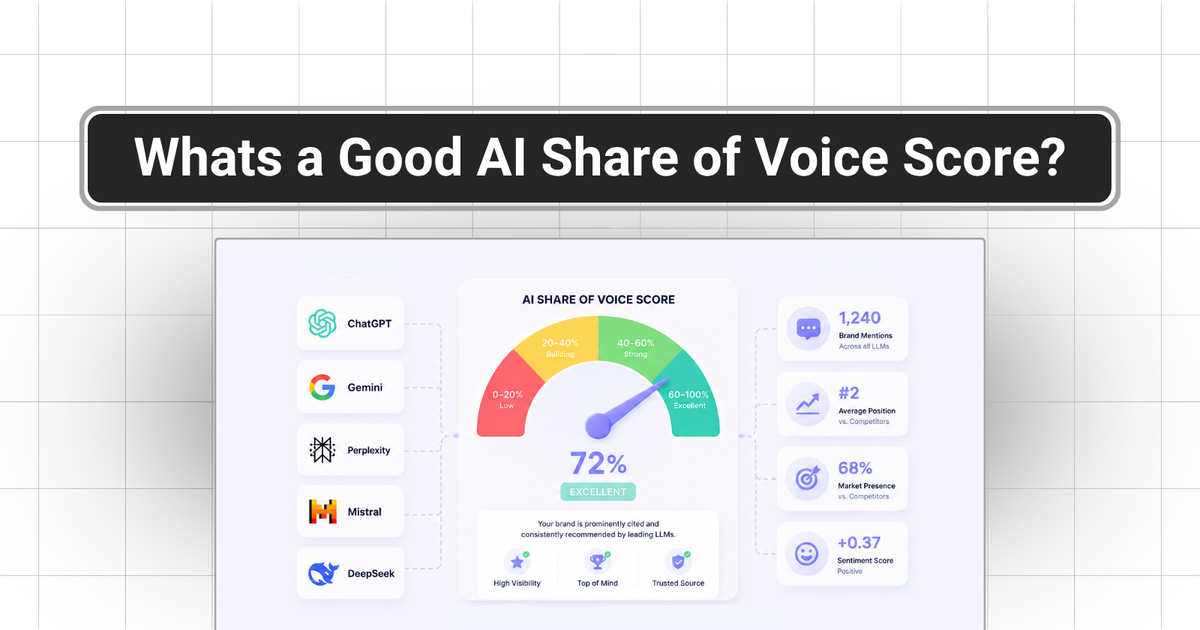
AI Share of Voice is the percentage of AI-generated answers, across engines like ChatGPT, Gemini, and Perplexity, where a brand gets named for a defined set of category prompts. There is no single good score. It depends on the engine, the query set, and how concentrated the market is, but real citation data gives you an honest way to calibrate one for your own brand.
Why There Is No Single Benchmark Number
Search volume itself is moving away from the channels marketers have benchmarked against for two decades. Gartner predicts traditional search engine volume will fall 25 percent by 2026 as more queries move to AI chatbots and virtual agents. That shift means AI Share of Voice inherits none of traditional search's stability.
This is also where GEO and SEO diverge most sharply. SEO benchmarks a ranking position on a stable results page. Generative engine optimization, or GEO, benchmarks a probabilistic answer that can change between two identical prompts run minutes apart, on the same engine, from the same account.
Engines also do not agree on which sources to trust. Averi's March 2026 audit of 680 million AI citations found that only 11 percent of domains cited by ChatGPT for a given prompt also get cited by Perplexity for that same prompt. A brand can rank strongly in one engine's answers and barely register in another, which is why a single blended number misleads more than it helps.
What the Data Shows About Strong vs Weak AI Visibility
A few real data points give you anchors instead of guesses.
Content structure moves visibility, not just tone. Princeton researchers tested nine content changes across roughly 10,000 queries and found that adding cited sources, statistics, and quotations lifted an AI engine's use of a page by up to 40 percent (Aggarwal et al., GEO: Generative Engine Optimization).
Engine overlap is low, so single-engine tracking undercounts your real share. Averi's 680 million citation study found only 11 percent domain overlap between ChatGPT and Perplexity citations for matching prompts.
AI-driven traffic is compounding fast enough to matter for revenue, not just visibility. Adobe's Q2 2026 AI Traffic Report found AI-referred visits to US retail sites grew 393 percent year over year in the first quarter of 2026.
Search behavior itself is shifting away from the channels most benchmarks were built on. Gartner projects a 25 percent drop in traditional search volume by 2026 as queries shift to AI chatbots.
How to Calculate and Benchmark Your Own AI Share of Voice
The calculation itself is simple. The judgment is in picking the right prompts and reading the result honestly.
Build a prompt set of 30 to 50 real buyer questions in your category, phrased the way a buyer would type them, not brand-name searches.
Run every prompt across at least three engines, ideally ChatGPT, Gemini, and Perplexity, on a fixed monthly schedule so results are comparable over time.
Count how many total answers mention your brand versus each named competitor, then divide by total answers to get a percentage share for each engine.
Track position and sentiment alongside share of voice. A brand mentioned less often but described favorably can outperform a competitor that gets named more often in neutral or generic terms.
A Worked Example: Benchmarking a Mid-Market SaaS Brand
Here's the math applied to a hypothetical mid-market SaaS brand running 50 category prompts across three engines, for 150 total AI answers. The brand appears in 18 of those 150 answers, for a raw AI Share of Voice of 12 percent. Its closest named competitor appears in 41 of 150, for 27 percent.
Neither number means much alone. What matters is the 15-point gap and where it opens up. If the brand's share drops into single digits specifically on Perplexity while holding steady on ChatGPT, that is the one engine to fix first, not the blended average. Rerunning the same 50 prompts monthly turns this from a one-time snapshot into an actual benchmark.
How Vizible AI Helps You Track and Improve Your Score
Vizible AI is a platform that tracks, analyzes, and helps improve how brands appear across AI answer engines, including ChatGPT, Claude, Gemini, Perplexity, Mistral, and DeepSeek. It reports on four metrics: Visibility, Position, Sentiment, and Share of Voice, so a benchmark like the one above updates on its own instead of requiring a manual prompt run every month.
Beyond tracking, Vizible AI's platform analyzes which sources each engine cites most often for your category, then generates GEO-ready content in one click to close the specific gaps that analysis finds. If your benchmark shows you're behind, pair it with a 90-day plan for improving AI Share of Voice to close the gap in a structured way instead of guessing at what to fix.
FAQ
What is a good AI Share of Voice score?
There is no fixed good score, because it depends on how many named competitors are in the category and how concentrated the market is. As a working rule, treat anything within a few points of the category leader as strong, and treat a share under half the average competitor's as a signal to prioritize GEO work.
How is AI Share of Voice different from traditional share of voice?
Traditional share of voice tracks paid media spend or organic search rankings against competitors. AI Share of Voice tracks how often an AI engine's generated answer actually names your brand for a real buyer question, which depends more on content structure and citation behavior than on spend.
How often should I re-benchmark my AI Share of Voice?
Monthly is a reasonable floor, because engine citation patterns and model versions change often enough that a quarterly check misses real swings. Categories with heavy competitive content pushes may need a check every two weeks.
Does AI Share of Voice vary a lot between ChatGPT, Gemini, and Perplexity?
Yes. Averi's 2026 citation study found only 11 percent domain overlap between what ChatGPT and Perplexity cite for the same prompts, so a brand can rank well in one engine's answers and barely appear in another. Benchmarking on a single engine will misstate your real position.
Can a small brand ever beat a big competitor's AI Share of Voice?
Yes, more often than in traditional search rankings. AI engines weigh how directly and clearly a page answers a specific prompt more than domain size or backlink volume, so a smaller brand with tightly structured, well-cited content can out-cite a larger competitor on specific queries, which is often the fastest way to rank on ChatGPT without matching a competitor's backlink profile.
What tools can track AI Share of Voice across multiple engines?
Purpose-built platforms such as Vizible AI, along with tools like Profound, Otterly, and BrandMentions, track brand mentions across AI engines. The meaningful differences between them are how many engines they cover, whether they analyze the sources each engine cites, and whether they help you act on the gaps they find.
Get Started
Guessing at your AI Share of Voice from spot checks in ChatGPT is not a benchmark, it's a snapshot. Start a 7-day free trial of Vizible AI to run a real benchmark across six AI engines and see exactly where your share is strong, where it's weak, and what to fix first.