



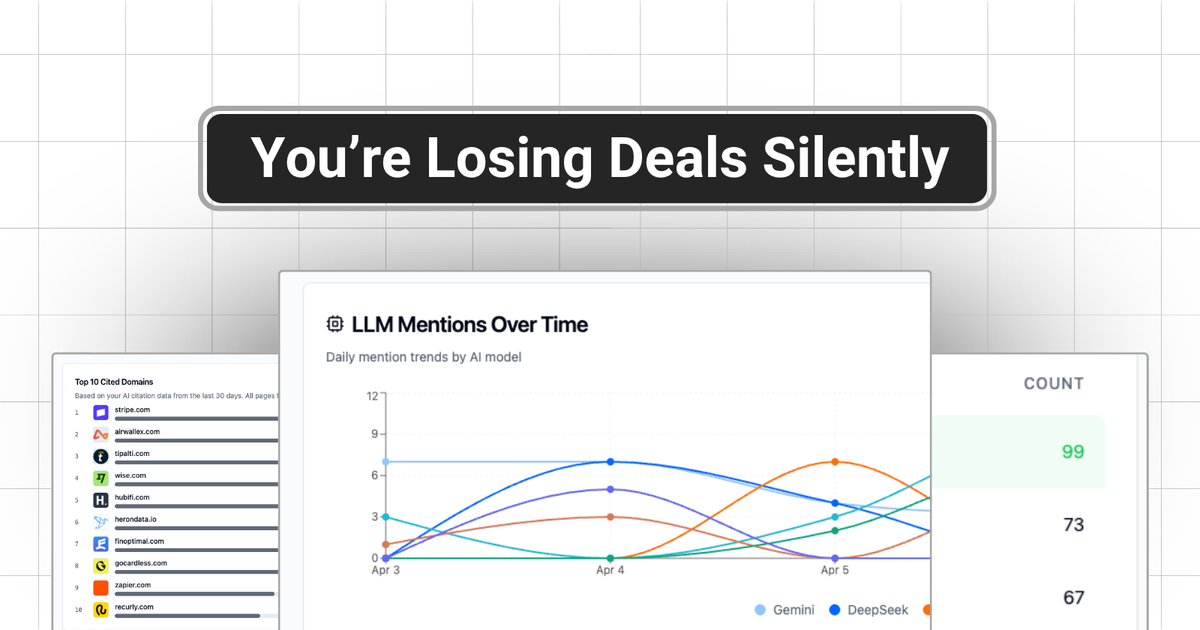
A SaaS marketing director shared a number with me a few weeks ago. He ran a simple test: typing his category query into ChatGPT. His main competitor showed up in 9 out of 10 responses. He showed up in 1. His Google rankings? Identical. His content? Objectively just as good. But in AI engines, he was almost entirely absent from the conversation.
What he was observing without naming it was his AI share of voice. And what that number revealed was that his competitor was quietly dominating the channel that was going to determine who makes the B2B buyer shortlist in 2026.
This guide explains exactly what AI share of voice is, how to calculate it, and what you can do concretely to improve it.
AI share of voice measures the percentage of brand mentions your company receives in LLM-generated responses, relative to total category mentions across those platforms. For the full formula, calculation method, and 2026 benchmarks, see our complete guide on what AI share of voice is and how to measure it. What that guide doesn't cover is what a low score costs you before a single sales conversation even happens — and that's the real risk for B2B teams.
73% of B2B buyers now use AI tools like ChatGPT and Perplexity in their research process, according to a study published in February 2026 by Machine Relations. Brands absent from those responses don't lose deals late in the process. They simply never enter the conversation in the first place.
AI share of voice is tomorrow's market share. Brands measuring it today are building a lead their competitors don't see coming.
Why this is fundamentally different from classic SEO
Classic SEO share of voice measures your visibility in Google's list of results: you were in position 3, your competitor in position 1. Traffic was shared but visible, measurable, attributable. The algorithm had known criteria you could adapt to.
AI share of voice works differently on three fundamental points. First, LLMs don't list: they recommend. A ChatGPT response on "best GEO tool" doesn't give 10 links. It gives 3 to 5 names with a description, and that's it. The first one cited has a considerable advantage. Second, being cited doesn't guarantee a click. According to Similarweb's 2026 GenAI Brand Visibility Index, publishers like Reuters and The Guardian receive less than 1% of their referral traffic from ChatGPT and Perplexity despite frequent citations. The goal is no longer to attract clicks but to build familiarity. Third, AI engines have different memories. Perplexity uses the live web in real time. ChatGPT relies on its training data with a cutoff date. Gemini combines both. Your share of voice can be strong on Perplexity and near zero on ChatGPT for the exact same prompts.
How to calculate your AI share of voice in 20 minutes
The manual method is simple and gives you a solid baseline. You need a spreadsheet, incognito access to ChatGPT, Perplexity, and Gemini, and 20 minutes.
Step 1: define your prompt universe
Build 15 to 20 prompts that represent what your buyers actually type into LLMs. Cover three types: category discovery prompts ("best AI visibility tracking tool"), comparison prompts ("Vizible AI vs [competitor] comparison"), and use-case prompts ("how to measure my share of voice in ChatGPT"). These 15 to 20 prompts become your permanent tracking corpus. Don't change them month to month: it's the stability of the corpus that makes time-based comparison meaningful.
Step 2: collect mentions across each engine
For each prompt, open an incognito session and run it in ChatGPT, Perplexity, and Gemini. In your spreadsheet, note for each response: which brands are cited, in what order, with what sentiment (positive, neutral, mixed). Do this across your entire corpus. At the end, count the total number of brand citations across all responses. Divide your citations by the total. That's your raw AI share of voice.
Step 3: break it down by engine and by prompt type
A global number hides very different realities. Your share of voice might be 35% on Perplexity (where recent content dominates) and 8% on ChatGPT (where older training data works against you). Same thing by prompt type: you can dominate discovery prompts and be absent from comparison prompts, which means you enter the options list but lose at the decision moment.
2026 benchmarks: where do you actually stand?
The first aggregated data published in early 2026 by platforms like Rankshift and Machine Relations provide some reference points. In competitive B2B categories (martech, SaaS, cybersecurity), category leaders reach 30 to 40% AI share of voice on their primary prompts. A share of voice between 15 and 30% is considered strong. Below 15%, you exist in the AI ecosystem but you're not a reference yet. Below 5%, you're essentially absent.
What surprises in audits: B2B brands appear on average in fewer than 30% of relevant category queries, regardless of their SEO position. A brand ranking number 1 on Google can have an AI share of voice of 4%. That's not an anomaly: it's the structural reality of an ecosystem with its own citation rules.
The 4 levers to grow your AI share of voice
A low share of voice isn't a death sentence. It has identifiable causes, and each cause has a concrete fix.
Lever 1: prompt coverage
The most common reason for low share of voice: you don't have content that answers the exact prompts your buyers are asking. According to a Growth Memo analysis published in March 2026, the top 4.8% of URLs most cited by ChatGPT are content that answers four questions on a single page: what is it, who uses it, how to choose, and what does it cost. If your site doesn't cover these four angles on your main category, you're structurally absent from a large share of responses.
Lever 2: independent citations
Brands are 6.5x more likely to be cited through third-party sources than their own domain in AI responses, according to position.digital data published in early 2026. That number changes everything: your internal blog is less impactful than a Product Hunt article, a mention in an industry newsletter, an authentic Reddit thread, or a detailed G2 review. Every consistent mention in a credible source is a vote for your AI share of voice.
Lever 3: entity consistency
If your LinkedIn description says "GEO platform", your homepage says "AI visibility tool", and your G2 profile says "LLM tracking software", models have a blurry picture of what you are. A blurry picture doesn't generate confident recommendations. Unify your description across all your presence points with the same keywords and the same positioning. It's two hours of work and the impact on RAG engines like Perplexity is measurable within weeks.
Lever 4: sentiment and accuracy
You can have a 25% share of voice and still lose if the description LLMs give of you is weak or inaccurate. "A tool that may work for teams on a tight budget" doesn't have the same effect as "the reference for B2B marketing teams who want to measure their visibility across all LLMs". If models have incorrect information about your pricing, features, or positioning, it usually comes from contradictory or outdated sources. The fix is updating your content and aligning your profiles.
AI share of voice by engine: what the 2026 data says
ChatGPT is the top priority for most B2B brands. It represents 77% of all AI-driven referral traffic in 2026 and holds 81% market share in the AI chatbot sector according to SE Ranking. But its citation logic is different from Perplexity's: ChatGPT relies more heavily on training data, which means recent sources have less immediate impact. Brands well-established in its training data have a structural advantage.
Perplexity is the most reactive engine to new publications. It indexes and cites recent content within days. It's the terrain where a quality article published this week can already appear in responses next week. For brands starting their GEO strategy, Perplexity is often where the first measurable results show up.
Gemini combines web freshness with the power of Google's index. Sites that perform well in traditional SEO tend to have stronger Gemini share of voice than on ChatGPT. It's the bridge between the two disciplines.
From manual calculation to continuous tracking
The manual method described here gives you a useful baseline. But it has one obvious limit: it's a snapshot. Your 22% share of voice today can be 15% in six weeks if a competitor publishes a comprehensive guide on your category and gets cited in three industry newsletters while you're not watching.
Best practice is to run a manual calculation once per quarter to verify your raw numbers, and to track your share of voice automatically in between. Continuous tracking turns a photo into a video: you see what's rising, what's falling, and you can connect every movement to a specific action.
AI share of voice measured once is a status report. Measured every week, it's a competitive advantage.
FAQ: questions everyone asks about AI share of voice
What's the difference between AI share of voice and mention rate?
Mention rate measures how many times your brand appears in a set of AI responses, in absolute terms. AI share of voice is a relative measure: it compares your mentions to all brand mentions in your category across the same prompts. A brand with 50 absolute mentions can have a 5% share of voice if its competitors accumulate 950 mentions. Share of voice is the competitive metric: it tells you not just whether you exist, but whether you dominate.
How many prompts do you need to track for a reliable measurement?
Most B2B brands start with 20 to 30 prompts. That's enough for a representative baseline. The 2026 Machine Relations study reveals that most brands track only 5 to 10 prompts when they should be tracking 50 or more for a complete picture of their coverage. The ideal is to build your corpus by intent: discovery prompts, comparison prompts, use-case prompts, and pricing prompts. Each category gives you different insights into where you're strong and where you're absent.
Does AI share of voice directly influence sales?
The impact is indirect but real. Visitors arriving from AI engines convert at twice the rate of visitors arriving through classic organic search, according to Conductor's 2026 analysis of 17 million AI responses. This is because someone who saw your brand recommended by ChatGPT arrives with higher-intent than an SEO visitor. AI share of voice doesn't directly generate deals, but it determines whether you're on the shortlist when the buyer makes their decision.
What's a realistic AI share of voice target for a B2B startup?
For a B2B startup in a competitive category, reaching 15% AI share of voice on your primary prompts within 6 months is a realistic and meaningful target. It's not dominance, but it's regular presence in responses, which is enough to get onto buyer shortlists. The long-term goal to become a category leader is exceeding 30% on your most strategic prompts. The most important metric isn't the absolute number but the trend: a brand moving from 8% to 18% in 60 days has momentum that predicts future category dominance.
AI share of voice is becoming the strategic indicator CMOs will watch alongside their Google market share. Teams measuring it today and acting on it are building a structural lead. Vizible AI automatically calculates and tracks your AI share of voice in ChatGPT, Gemini, Claude, Perplexity, Mistral, and DeepSeek every day, across all your category prompts. You see your score, your competitors' scores, and the trend over time.