



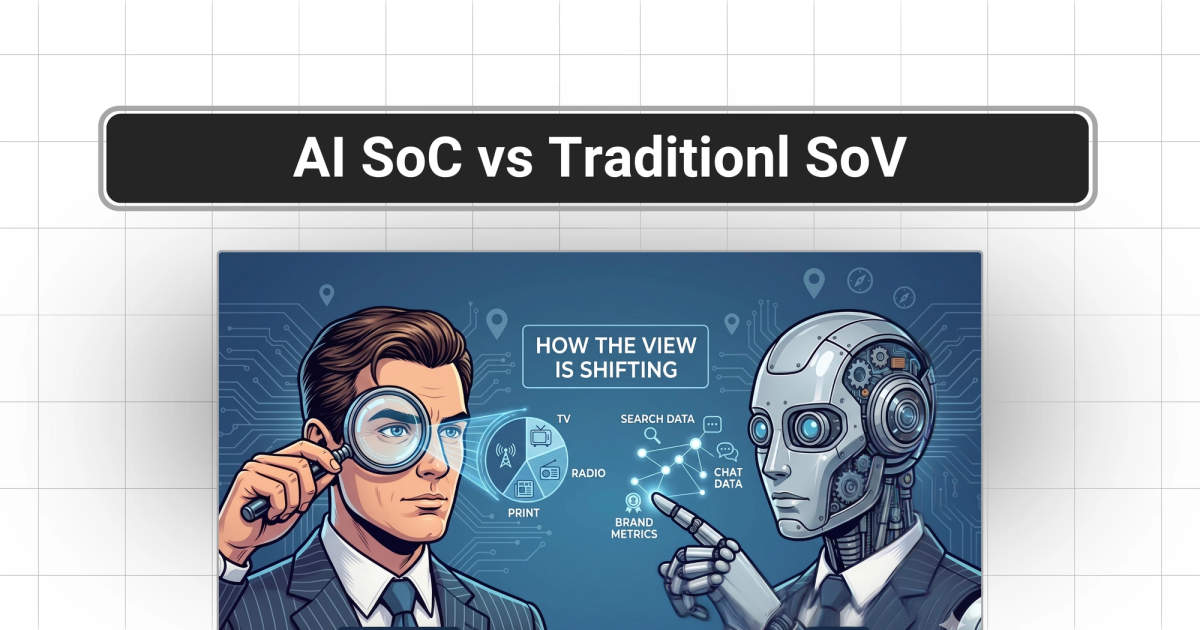
Share of voice has been a cornerstone marketing metric for decades. You measured your brand's portion of total media spend, search impressions, or social mentions in your category, then compared it to competitors. The formula was stable.
AI search has broken that formula. When someone asks ChatGPT or Perplexity which project management tool to use, no one paid for placement. There's no impression share to buy. The brand that gets cited earned it through authority signals that have nothing to do with traditional SOV drivers. Which is why the two metrics, though they share a name, measure fundamentally different things.
What traditional share of voice actually measures
Traditional share of voice originated in broadcast advertising. In its original form, it was your ad spend as a percentage of total category spend. If your industry spent $10 million on TV ads and you spent $1 million, your SOV was 10%.
Digital channels expanded the definition. Today, traditional SOV covers paid search impression share, organic search visibility, and social media conversation share. The measurement channel changes, but the logic holds: count how often you appear, divide by the total, and get a percentage.
It's a competitive metric built around controllable channels. You increase traditional SOV by spending more, publishing more, or outranking competitors on defined keywords. The levers are understood and, to a significant degree, buyable.
What AI share of voice measures, and what it doesn't
AI share of voice is the proportion of AI-generated responses about your category that include a mention or citation of your brand, relative to all brand mentions in that category across AI platforms.
Where traditional SOV tells you how visible you are in media and search, AI SOV tells you how present you are in the answers people are actually reading. That distinction matters more every year. According to a multi-source analysis published on PR Newswire, 73% of B2B buyers now use AI tools during their purchase research process. ChatGPT alone has 900 million weekly active users globally, with roughly 49% of all messages classified as information-seeking queries, per OpenAI's own data published in February 2026.
AI share of voice doesn't measure spend. It doesn't measure keyword rankings. It measures something closer to earned authority: whether AI models consistently include your brand when someone asks about your category. That's a fundamentally different competitive dynamic.
Six ways they differ (and why each one matters)
1. The channel
Traditional SOV tracks paid placements, organic rankings, and media coverage across channels you can directly influence with budget. AI SOV tracks your presence in AI-generated answers, which no amount of ad spend buys directly. According to Edelman research, 90% of AI citations driving brand visibility originate from earned and owned media, not paid placements.
2. The measurement unit
Traditional SOV is measured in impressions, clicks, or spend share. AI SOV is measured in citation frequency and brand mention rate across AI responses. A brand with 40% Google impression share might have just 3% AI share of voice if it lacks the authority signals AI models rely on. These metrics don't move together, so you can't infer one from the other.
3. The predictors
Traditional SOV responds to budget, keyword targeting, and content volume. AI SOV responds to domain authority (traffic-based, not just a DA score), external brand mentions across forums and review sites, content freshness, and structural clarity. SE Ranking's analysis of 2.3 million pages found that domain traffic is the strongest predictor of AI citations, with high-traffic sites earning 3x more AI citations than low-traffic ones.
4. The decoupling from Google
An Ahrefs study published in August 2025 found that roughly 80% of URLs cited across major AI platforms do not rank in Google's top 100 results for the same queries. Your traditional SOV can be growing while your AI SOV is flat or falling, and you won't see the divergence unless you're measuring both.
5. The platform variation
Traditional SOV is measured consistently within a channel. AI SOV varies dramatically by platform. Superlines analyzed 34,234 AI responses across 10 platforms and found that citation rates differ by up to 615x between the most- and least-citing platforms. A brand performing well on Grok may be completely absent on Gemini. Single-platform tracking gives you a fraction of the picture.
6. The volatility
Traditional SOV metrics shift gradually, tied to campaign cycles or content output. AI SOV can swing significantly in weeks. Superlines' own tracking from January to February 2026 showed brands losing 34% of their AI share of voice in just five weeks with no change to their underlying content strategy. This is not a set-it-and-forget-it metric. Quarterly audits are not enough.
How to track both, and which one to prioritize
The short answer: track both. Traditional SOV still matters for brand awareness, campaign measurement, and media planning. But AI SOV is now a leading indicator of pipeline. AI referral traffic converts at 14.2%, compared to Google organic's 2.8% (Exposure Ninja, 2026). Visitors arriving from AI citations are already in consideration mode. They researched, got a recommendation from ChatGPT or Perplexity, and then clicked through.
The practical challenge: traditional SOV tools (Semrush, Moz, Brandwatch) don't measure AI presence. They weren't built for it. AI share of voice requires sending test prompts to multiple AI engines, then measuring how often your brand appears, in what position, and with what sentiment.
Vizible AI tracks brand presence across seven AI engines simultaneously, measuring citation frequency, sentiment, position, and share of voice in a single dashboard. If you're comparing your AI share of voice against competitors, that kind of multi-engine measurement is the only way to get reliable numbers. For more on how AI share of voice is calculated, see our guides on AI share of voice: definition and calculation and how to measure and improve your AI share of voice.
On prioritization: start with AI SOV for categories where buyers research before buying, B2B SaaS, professional services, financial products, high-consideration consumer goods. For brand campaigns and media buying, traditional SOV remains relevant. The goal is running both in parallel.
Frequently Asked Questions
What is AI share of voice?
AI share of voice is the percentage of AI-generated responses about your category that include your brand, relative to total brand mentions in that category across AI platforms like ChatGPT, Gemini, and Perplexity. It measures earned presence in AI-generated answers, not paid or organic search visibility.
Is AI share of voice replacing traditional share of voice?
Not replacing, but supplementing. Traditional SOV measures paid and organic media presence. AI SOV measures how AI engines represent your brand in conversational answers. Both provide distinct competitive intelligence. Brands that track only one are missing part of how their market perceives them.
Can you buy your way into AI share of voice?
No, not directly. AI citations are driven by earned signals: domain authority, external brand mentions, content structure, and freshness. Ad spend does not buy placement in AI-generated answers. Advertising can increase brand awareness signals that AI models pick up over time, but there is no direct-buy equivalent.
How often does AI share of voice change?
More frequently than traditional SOV. Superlines data shows brands can lose over a third of their AI share of voice in five weeks. AI models update constantly, citation behavior shifts with content freshness, and different prompts trigger different results. Weekly monitoring is the minimum for brands that depend on AI search for discovery.
Which AI platforms matter most for share of voice?
It depends on your audience and category. ChatGPT currently drives 87.4% of all AI referral traffic (Conductor, 2026), making it the priority for traffic impact. But citation behavior varies dramatically by platform: Grok has a 27% citation rate while ChatGPT has 0.59% (Superlines, March 2026). Optimizing for one platform is not enough.
See Your Brand's AI Share of Voice Right Now
Traditional share of voice tells you where you stand in media and search. AI share of voice tells you where you stand in the answers people trust. Vizible AI measures your brand's AI presence across seven engines, tracking citations, sentiment, position, and competitive share of voice in one dashboard. Start your free 14-day trial, no credit card required.