



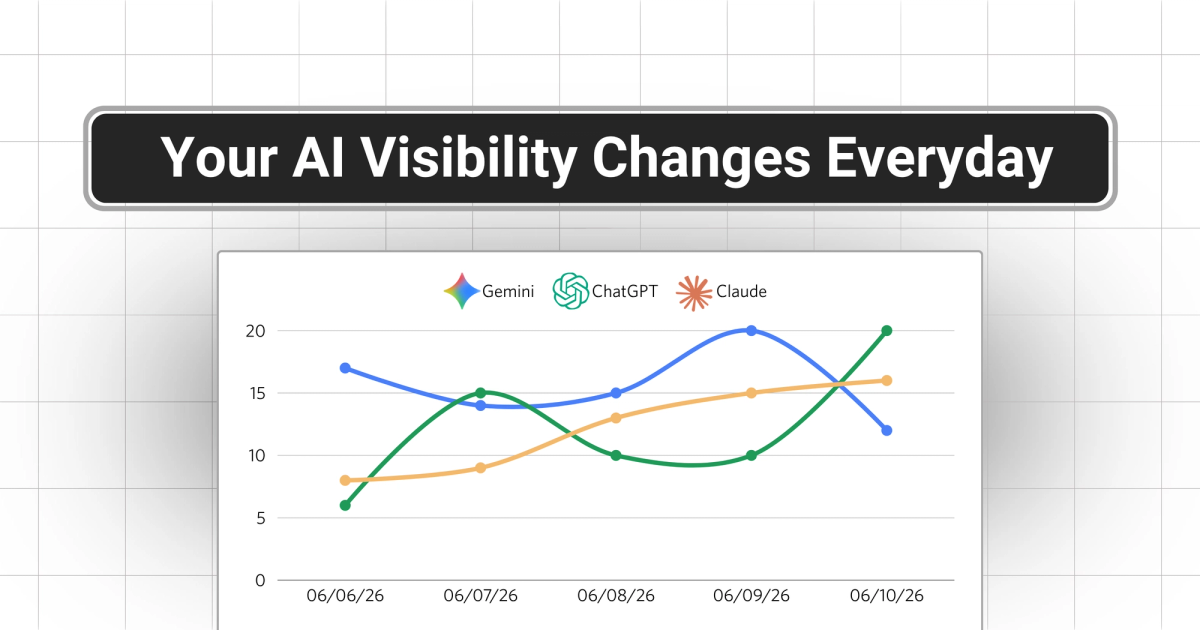
You opened ChatGPT, typed your category name, and your brand was there. Good news. But if you run the same search in an hour, you might get a completely different response. And tomorrow, another one still. An academic study published in April 2026 documents this with empirical data: LLMs are stochastic by nature, and measuring your AI visibility once tells you nothing reliable. The question is not whether you appear. It is how often, across how many prompts, and with what stability over time.
What Stochastic Means in Practice
A language model does not produce the same response every time. It generates text by selecting tokens according to probability distributions, introducing variation at each generation. Two factors amplify this effect. The first is the model's temperature: the higher it is, the more responses vary. The second is search context: when an LLM with web access retrieves sources in real time, the search results it fetches also change from one query to the next.
Concretely, asking ChatGPT the same question ten times in a row can produce ten responses mentioning different brands, in different orders, with different phrasing. Sill, which analyzes LLM visibility data across hundreds of brands, measured that only 2.7% of competitor sets cited are identical from one day to the next. That single figure should be enough to permanently retire the practice of manual one-off testing.
Why Manual Testing Misleads You
The most common practice in marketing teams in 2026 is still manual checking: open ChatGPT, ask the question, note whether the brand appears. This approach has five structural problems that make it unusable as a tracking system.
First problem: you are measuring a single point in a distribution. Your brand might appear 40% of the time on this query. Whether you caught it or not depends on when you tested. Second problem: you are only covering one platform. Checking ChatGPT alone means you miss 89% of non-overlapping citations according to Omniscient's analysis. The competitor you think you are beating on ChatGPT may be dominant on Perplexity, Gemini or Claude. Third problem: you are only testing one prompt. LLMs decompose complex queries into dozens of sub-queries via query fan-out. Your real visibility is the sum of hundreds of prompt combinations, not a single test.
Fourth problem: results vary with phrasing. The same intent expressed differently produces very different responses. "Best GEO tool" and "software to measure AI visibility" share the same intent but occupy distinct response spaces. Fifth problem: you have no baseline. Without historical data, it is impossible to know whether you are progressing or regressing. A measurement without a time reference is not a measurement, it is an anecdote.
AI Visibility Is a Distribution, Not a Score
This is the central paradigm shift that the April 2026 study formalizes. AI visibility cannot be measured like a Google ranking, where your position is stable and verifiable at any time. It is measured as a mention frequency across a large number of runs. The right question is not whether you appear in ChatGPT, but how often you appear across a representative set of prompts, measured repeatedly over time.
The method emerging as the industry standard draws from election polling models. It involves defining a representative sample of 250 to 500 high-intent prompts in your category, running them automatically across multiple models, and calculating an average mention rate across the set. That rate, calculated daily, produces a reliable trend curve that neutralizes the individual variance of each prompt.
The study also introduces stability as a critical metric complementary to visibility. A brand can have a high mention rate but very unstable: it appears often but unpredictably, varying by day and by phrasing. Another may have a lower rate but very stable. These two profiles have different strategic implications. The unstable brand has fragile citation authority, liable to disappear the moment a competitor publishes stronger content. The stable brand has built a solid association in the model's parameters.
What Your Competitors Are Doing While You Test Manually
The practical consequence of measuring incorrectly is that you make strategic decisions on false data. You are convinced you appear because you saw your brand once. You conclude a competitor is absent because they were not in the result you checked. Meanwhile, that competitor is running 500 prompts automatically every day, measuring their mention rate at 37% on ChatGPT and 52% on Perplexity, and detecting they have gained 8 points over two months from a new content series.
The gap between brands that measure correctly and those that test manually will widen. The former have a feedback system that lets them iterate quickly: they know what works, what does not, and they adjust. The latter are navigating blind.
The GEO Metrics That Replace "I Checked in ChatGPT"
A rigorous GEO measurement system rests on four core metrics. The first is mention rate: across your full set of target prompts, how often is your brand named? This is your baseline metric, to be tracked by platform and by prompt category. The second is AI share of voice: among all brands cited on your prompts, what proportion goes to you? This metric positions you relative to your direct competitors.
The third is stability: is your mention rate consistent over 30 days or does it vary widely? High variance signals fragile citation authority. The fourth is sentiment: when you are cited, how are you described? Positive, neutral, or with reservations? A brand cited frequently but with ambiguous sentiment can lose deals upstream of the click.
How Many Prompts and Runs Are Needed for a Reliable Measurement?
The general rule from 2026 practice: a minimum of 50 well-constructed prompts already covers the main angles of a category. Between 250 and 500 prompts is the recommended representative sample for a B2B SaaS brand with multiple use cases. Below 30 prompts, results are not statistically stable.
On measurement frequency: daily is the minimum cadence to detect significant variations. Weekly, you miss fast-moving events like a competitor launch, an OpenAI policy change, or a major model update that can shift your visibility by 15 points in 48 hours. Monthly, you are not measuring: you are discovering damage after the fact.
Vizible AI Measures Your Visibility as a Distribution, Not a Screenshot
That is exactly what Vizible AI does: the platform automatically runs your target prompts across ChatGPT, Gemini, Perplexity, Claude, Mistral, DeepSeek and Groq every day. It calculates your mention rate across your full prompt set, tracks your share of voice against competitors, measures the stability of your citations over time, and analyzes the sentiment associated with each mention. The result is a distribution, not a score. A trend, not an anecdote.
The difference from manual checking is structural. A manual check tells you what happened once. Vizible AI tells you what happens on average, how it is evolving, and what your competitors are doing while you are not watching.
Frequently Asked Questions
Why does ChatGPT give different answers to the same question?
LLMs generate text by selecting tokens according to probability distributions, not deterministically. The temperature parameter controls the level of variation: the higher it is, the more responses diverge. When the model accesses the web in real time, the sources it retrieves also vary between queries, amplifying the difference in output.
How many times do I need to test a prompt to get a reliable result?
There is no universal figure, but 2026 practice converges on a minimum of 30 to 50 runs per prompt to establish a stable mention rate. In practice, the more scalable approach is to expand the number of prompts rather than multiply runs on a single prompt. A set of 50 prompts run daily produces a much more actionable trend curve.
Do all LLMs vary equally?
No. Variance depends on each model's temperature settings and web access. Models with real-time search tend to vary more than models responding solely from parametric knowledge. This is one of the reasons why monitoring multiple LLMs simultaneously gives a more reliable picture than focusing on just one.
Can I improve the stability of my AI citations?
Yes. Stability increases when your brand is consistently present across multiple independent sources: your site, LinkedIn, G2, industry publications. The more LLMs find your brand cited in varied sources on your target topics, the more robust the association becomes and the less sensitive it is to stochastic variance.
What is the difference between mention rate and AI share of voice?
Mention rate measures the absolute frequency at which your brand appears in responses. AI share of voice is relative: it compares your mention rate to that of your competitors across the same prompts. A brand can have a mention rate of 45% that looks good in absolute terms, but a share of voice of only 18% if competitors dominate the remaining responses.
Measure Your AI Visibility the Way It Should Be Measured
A manual test in ChatGPT is an anecdote. Vizible AI is a measurement system. The platform runs your prompts every day across 7 LLMs, calculates your mention rate and share of voice in real time, and shows you whether you are gaining or losing ground while your competitors do the same. Start your free 14-day trial at Vizible AI, no credit card required.