



How to Run a Competitive AI Share of Voice Analysis
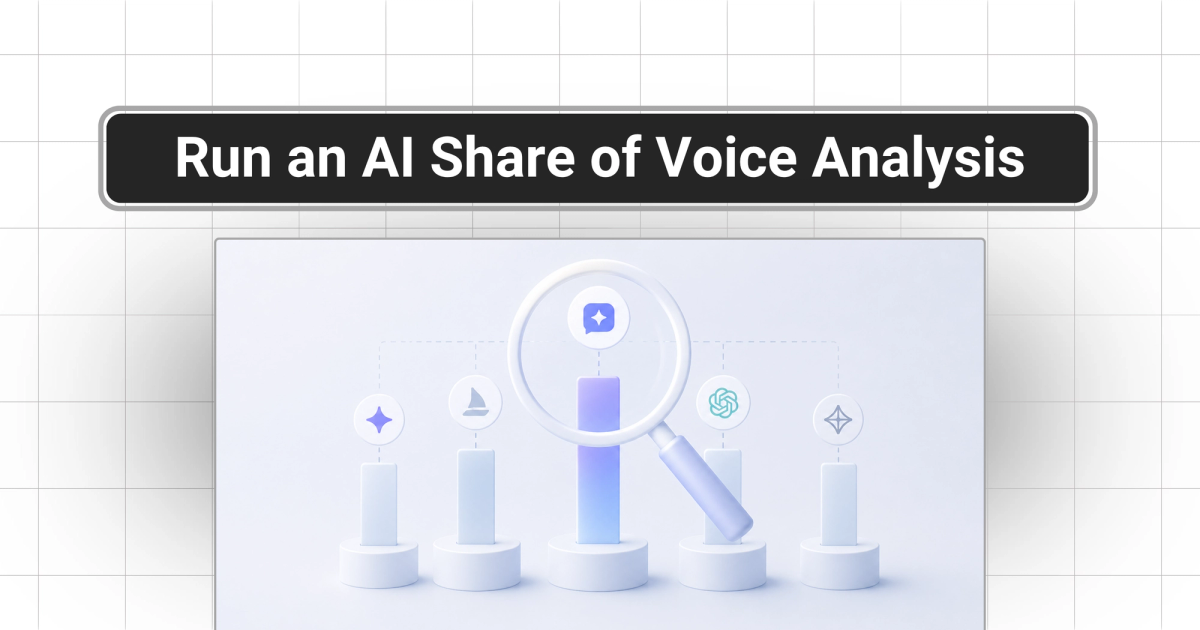
A competitive AI Share of Voice analysis maps how often your brand and your competitors are cited in AI-generated answers, across the same set of buyer queries, on the same engines. The output tells you something your analytics dashboard can't: which companies are being named when buyers ask the questions that lead to purchases, and whether you're one of them.
Forrester's 2026 Buyers' Journey Survey of 18,000 global business buyers found that 94% of B2B buyers now use AI during the purchase process, with twice as many naming it their most meaningful research source over vendor websites, sales reps, or product experts. The shortlist is being assembled before any vendor conversation starts. If your competitors appear in those AI answers and you don't, you're not being filtered out later. You were never in the room.
Why Tracking Only Your Own Metrics Misses the Point
When most teams first set up AI visibility tracking, they focus entirely on their own brand. That's the natural starting point. But a citation rate of 22% tells you very little without context. Is 22% strong in your category, or are your top three competitors each sitting at 45%? The number only has meaning relative to what everyone else is getting.
This is the same logic that made traditional share of voice a more useful metric than raw impression counts. AI Share of Voice works the same way, with one added variable: the citation landscape is radically fragmented across engines. A brand that leads on ChatGPT can trail badly on Perplexity. Tracking your own numbers in isolation, on a single engine, gives you a data point. Tracking it competitively, across all six major engines, gives you a strategy.
Step 1: Define Your Competitive Set and Query Universe
Start by listing the three to five brands your buyers consider alongside you. Include one aspirational competitor you're not yet matching, and one challenger brand you consistently outperform. The goal is to map real purchase-consideration dynamics, not a theoretical landscape.
Next, build a query set of 20 to 50 prompts that mirror how your buyers actually research in AI. These should span three intent types: category-level queries (what's the best tool to track AI brand visibility), problem-framing queries (how do I know if my brand appears in ChatGPT), and comparison queries (brand X vs brand Y). Cover the full funnel. Awareness queries tell you who gets discovered first. Decision-stage prompts tell you who gets recommended last. Both matter.
Step 2: Run the Audit Across All Six Major AI Engines
A brand that appears in 40% of ChatGPT responses for your query set may appear in only 12% of Perplexity responses for the exact same questions. Each engine uses different source-selection logic, different crawl schedules, and different citation formats. Running the audit on only one or two engines produces a partial picture that can point you in the wrong direction entirely.
The six engines that matter for most brand categories in 2026, and what each one prioritizes:
ChatGPT (OpenAI): 2 to 4 citations per response, strongly favors high-domain-rating editorial sources and well-established news outlets.
Perplexity: 5 to 12 citations per response, indexes Reddit, G2, Capterra, and academic sources heavily, often surfacing community and review content alongside editorial.
Gemini (Google): follows Google's organic authority signals and its own news index, making traditional SEO authority more transferable here than on other engines.
Claude (Anthropic): 2 to 3 citations per response, favors long-form editorial and research-backed content with clear sourcing and named authors.
Mistral: growing adoption across European enterprise buyers, with stronger citation of French and German-language professional sources than other engines.
DeepSeek: increasingly relevant in APAC markets and for multilingual searches, with source authority patterns that differ significantly from its Western counterparts.
Running this manually across six engines and 30+ queries produces hundreds of responses to parse every month. Vizible AI's multi-engine tracking platform runs the full audit simultaneously, producing a unified competitive map rather than six separate spreadsheets.
Step 3: Analyze the Source Citation Gap
Citation counts tell you who's winning. The source analysis tells you why, and that's where you find the actual fix.
Ahrefs' analysis of ChatGPT's citation behavior found that 65.3% of ChatGPT's top-cited pages come from domains with domain rating 80 or higher. A separate Muck Rack analysis of over one million AI prompts found that more than 85% of non-paid AI citations originate from earned media rather than owned content. If a competitor is being cited via Forbes, TechCrunch, and G2 while your brand appears only via your own homepage, that's not a content problem. It's an earned authority gap, and the fix looks completely different.
For each competitor you're auditing, look at three things: which publications back their highest-frequency citations, whether those publications have covered your brand in the same context, and whether the cited content directly answers the buyer's query or is being pulled tangentially. The third point matters because AI engines extract from content, they don't simply index it. A 3,000-word article that only briefly addresses the buyer's question performs worse than a 600-word piece that answers it head-on.
Step 4: Map Your Content Gaps Against Competitors
A content gap in the AI context is a specific combination of topic, format, and source authority that AI engines can't find when they look for an answer about your category. The process for mapping yours:
List every query in your test set where competitors appear and you have zero citations.
Identify which specific sources AI engines cite for those competitors on those exact queries.
Check whether those sources have ever covered your brand at all, and if so, in what context.
Flag queries where your own content exists but isn't being cited, since these signal a structural or authority issue rather than a simple coverage gap.
Prioritize gaps by query volume and buyer intent stage, starting with decision-stage queries where competitors appear and you don't.
The queries where you have zero citations despite publishing content on the topic are usually the most valuable to address. They show that your content exists but isn't recognized as authoritative enough to cite. That typically points to one of three causes: the content lacks verifiable statistics, it doesn't answer the buyer's question directly enough, or there aren't sufficient third-party references from sources AI engines already trust.
Step 5: Close the Gap with Targeted GEO Content
Once your gap map is built, the content agenda becomes straightforward. Focus first on the query categories where competitors are cited from sources that have covered you but not in the right context. A single well-placed article in the right publication, framed specifically around the buyer's question, can shift citation rates within 60 to 90 days.
The GEO tactics that move citations most reliably are covered in detail in Vizible AI's guide to increasing your AI Share of Voice. The short version: add verifiable statistics with sourcing, structure content around direct questions and answers, and earn coverage in the publications that AI engines already cite for your competitors.
Vizible AI runs competitive AI Share of Voice tracking across all six major engines, surfaces your source citation gaps, and generates GEO content outlines built around the exact queries where competitors are outpacing you. Start your 7-day free trial at vizibleai.com and have your first competitive audit running within the hour.
Frequently Asked Questions
What is a competitive AI Share of Voice analysis?
A competitive AI Share of Voice analysis measures how often your brand and your competitors are each cited in AI-generated answers for the same set of buyer queries, across multiple AI engines. It tells you where you lead, where you trail, and which sources are driving the gap.
How often should I run a competitive AI Share of Voice analysis?
Monthly is the right cadence for most brands. AI engines update their source indexes frequently, and competitor PR activity, third-party coverage, or your own GEO efforts can shift citation rates within a few weeks. Monthly tracking catches meaningful moves without getting lost in weekly noise.
Which AI engines matter most for B2B brands?
ChatGPT and Perplexity currently handle the largest share of B2B purchase research. Gemini is growing fast, particularly for buyers embedded in the Google Workspace ecosystem. Claude, Mistral, and DeepSeek matter for specific verticals and geographies. Track all six and weight your GEO effort toward the two or three where your category buyers are most active.
How long does it take to close a competitive AI Share of Voice gap?
Consistent improvements typically appear within 60 to 90 days of running a focused GEO content program. The fastest gains usually come from filling source citation gaps: earning coverage in the publications that AI engines already cite for your competitors, framed around the specific queries where you have zero citations.
Do I need a dedicated tool to track competitors in AI answers?
Manual tracking of five competitors across six AI engines and 30+ queries produces hundreds of responses to analyze each month. A monitoring platform handles data collection, source attribution, and citation trending automatically. The output is a gap analysis you can act on rather than a spreadsheet you have to build first.