



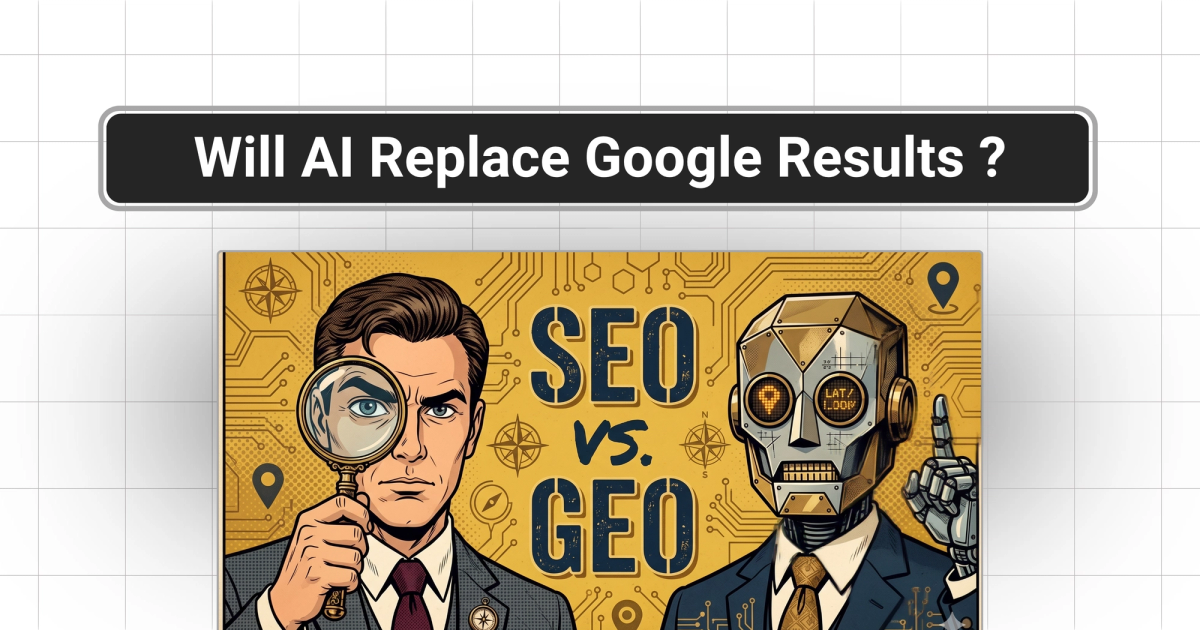
GEO vs SEO: What Changes When AI Replaces Search Results?
In May 2025, 69% of news-related Google searches ended without a single click to a website, up from 56% the year before (Marketing LTB, 2025). If you are still measuring content success by keyword rankings alone, you are tracking a metric that loses explanatory power every quarter. GEO vs SEO is the comparison that now defines where you invest: in ranking on a list that fewer people scroll, or in appearing inside the AI-generated answer they read instead.
What Is the Difference Between GEO and SEO?
GEO is the practice of structuring your content and digital presence so that AI-powered platforms cite, reference, or quote your brand when users ask questions. The goal is not a position on a results page. It is a sentence inside the answer itself, where the user may never click further.
SEO, by contrast, is the practice of improving web pages so search engines rank them higher, driving users to click through to your site. Both disciplines share a technical foundation: indexed, crawlable content from an authoritative domain. Above that foundation, the optimization logic diverges completely. SEO asks “how do I rank?” GEO asks “how do I get cited?”
This distinction changes what good content looks like, how you measure success, and which resources you prioritize. A page built to rank well on Google and a page built to get cited inside a ChatGPT answer can look very different, even when they target the same topic. Understanding where the two strategies overlap and where they diverge is what this post covers.
The urgency is practical, not theoretical. By mid-2025, approximately 5.6% of all U.S. searches were conducted using AI-powered LLMs as the primary search interface (Incremys, 2026). That share is growing every month. Brands that treat GEO as a future problem are already losing ground to competitors who began optimizing for AI citations in 2024.
The Zero-Click Shift That Makes GEO Urgent
Zero-click searches are not new, but AI has compressed a decade of gradual change into two years. The click rate on a position-1 organic result that sits below a Google AI Overview is now just 2.6% (Incremys, 2026). The zero-click rate has crossed 69% for news-related queries (Marketing LTB, 2025). Users are reading the answer, not the source page.
At the same time, AI chatbots have become a traffic channel in their own right. AI chatbot referral traffic reached 1.1 billion visits in June 2025, a 357% year-over-year increase (Incremys, 2026). That is not a rounding error. It is a new distribution channel scaling faster than traditional search did in its first years. The visits that disappear from organic search are partially reappearing as referrals from ChatGPT, Perplexity, and Gemini, but only for brands that get cited.
The strategic implication is uncomfortable: a page that ranks number 2 on Google for a high-intent query can simultaneously have zero AI Share of Voice for that same query. You can be winning the SEO game and invisible in the AI channel at the same time. Understanding why Google-ranking pages get ignored by AI chatbots explains the structural reasons behind that gap.
What GEO-Optimized Content Actually Looks Like
GEO does not require writing separate content for each AI platform. ChatGPT, Perplexity, Gemini, and Google AI Overviews all draw from indexed web content, and they share a set of preferences that translate into practical writing choices.
The most important is answer-first structure. Each section of your content should open with a direct, complete answer to the implied question. If a section is titled “What is GEO?” the first sentence should define GEO completely, not build toward a definition over three paragraphs. AI systems extract answers from the top of sections, not from narrative conclusions. Headings should be declarative statements or genuine questions. Generic labels like “Overview” or “Background” give AI systems nothing to anchor on.
Citation volatility is the factor most SEO practitioners underestimate. Research from 2026 shows that between 40% and 60% of cited sources rotate month-to-month across Google AI Mode and ChatGPT (Naturaily, 2026). A well-built SEO page can hold a position 3 ranking for two years. A well-built GEO page can lose AI citations within 30 days if a competitor publishes a more direct, more specific version of the same content. This is why tracking your AI Share of Voice is a continuous activity, not a quarterly audit.
The Metrics That Separate GEO vs SEO Performance
SEO performance is measured through keyword rankings, organic traffic volume, click-through rate, and domain authority. These metrics exist, are well-understood, and are captured by dozens of established tools. None of them capture what matters for GEO.
The core GEO metric is AI Share of Voice: the percentage of relevant queries where your brand or content appears in AI-generated responses. Beyond that, you need citation rate (how often you appear across the queries you track), citation sentiment (whether mentions are positive, neutral, or corrective), and citation consistency (how stable your visibility is week over week, given the 40–60% monthly churn).
The revenue tie-in is direct. 44% of consumers now use AI as their primary information source when making a purchasing decision (Incremys, 2026). A brand with zero AI Share of Voice is absent from nearly half of all buyer research journeys, even if it ranks on page one of Google. That is the number that turns GEO from an experiment into a budget line.
GEO metrics also reveal something that SEO metrics cannot: how your brand is framed, not just whether it appears. An AI citation that mentions your product as an example of a common problem is worse than no citation. Monitoring sentiment alongside frequency gives you a complete view of how AI platforms position you relative to competitors, and whether the positioning supports your messaging.
Do You Still Need SEO When You Are Doing GEO?
Yes, and the data is unambiguous. 99% of AI Overviews cite pages that appear in Google’s organic top 10 (Marketing LTB, 2026). Technical SEO (crawlability, page indexing, internal linking, site speed, domain authority) is the infrastructure that makes GEO possible at all. Without a page that Google has indexed and ranked, there is nothing for an AI system to retrieve.
The relationship becomes clear in practice. Consider a B2B software company with 40 pages ranking on page one for mid-funnel keywords. When they began tracking AI Share of Voice, they found that only 4 of those 40 pages appeared in AI-generated answers about their software category. The 36 excluded pages had strong rankings, but they were written in a style optimized for human browsing: narrative introductions, gradual reveals, conclusions at the end. After rewriting section openers to lead with direct answers, adding FAQ sections, and embedding specific citations with named sources and dates, 17 of the 36 pages began appearing in AI responses within 90 days.
SEO built the foundation. GEO restructured the content on top of it. The two strategies are not alternatives: one is the precondition for the other. Only 34% of companies have trained their teams in GEO as of 2026 (Incremys, 2026), which means the brands investing in this now carry a real first-mover advantage over the majority that are still optimizing exclusively for rankings.
How to Move from SEO to GEO Without Starting Over
You do not need to rebuild your content library from scratch. Start with an audit of pages that already rank for queries your audience actually asks AI platforms. For each page, ask four questions: does it open with a direct, answer-first paragraph? Does it contain an explicit definition section? Does it have a FAQ? Does it cite specific data with named sources and years?
Pages that score well on those questions already have GEO potential. They typically need a FAQ section added and perhaps a FAQ schema markup layer to help AI systems parse the questions and answers accurately. Pages with soft-sell introductions, heavy narrative framing, or vague claims backed by no sources need more substantial rewriting. Prioritize by query volume and purchase intent, exactly as you would in any SEO prioritization exercise.
Entity clarity is one area where GEO diverges from SEO in practical execution. AI systems orient their answers around named entities: specific brands, products, technologies, and concepts. Content that refers to “our platform” throughout instead of naming it, or that discusses “major AI tools” without specifying ChatGPT, Perplexity, and Gemini, gives AI systems less to work with. Being specific by name throughout your content is not keyword stuffing. It is how you make your content parseable to a language model.
A second practical difference is the role of citations within the content itself. SEO content often hedges claims with phrases like “research suggests” or “experts believe.” GEO content names the research and the expert. “A 2025 study by Gartner found that 44% of B2B buyers used AI tools as their primary discovery channel” performs better than “many buyers are now using AI.” The specificity signals credibility to both human readers and language models. For a close look at how one major platform makes its citation decisions, this breakdown of Perplexity’s citation logic is worth reading before you start rewriting.
Frequently Asked Questions About GEO vs SEO
Is GEO replacing SEO?
GEO is not replacing SEO. The data from 2026 is clear: 99% of AI Overview citations come from pages already ranking in Google’s top 10. Without indexed, authoritative content, there is nothing for AI systems to cite. GEO adds a content structure and monitoring layer on top of a working SEO foundation. The two are complements, not substitutes.
Which AI platforms should I prioritize first?
Start with the platforms your specific audience uses most. For most B2B and B2C brands in 2026, that means ChatGPT, Perplexity, Google AI Overviews, and Gemini. Each platform has different citation patterns, so monitoring your AI Share of Voice across all four simultaneously gives you a complete picture. Optimizing for one and ignoring the others leaves gaps that competitors will fill.
How quickly can GEO show results?
Citation volatility works in your favor here. Because 40 to 60% of cited sources rotate month-to-month, well-structured content can begin appearing in AI answers within weeks of being updated, rather than the months required for a traditional SEO rank improvement. The flip side is that GEO visibility requires continuous monitoring to catch and respond to drops before they persist.
Can I track GEO results manually?
You can run spot checks by querying AI platforms directly and recording whether your brand appears. With citation rates shifting 40 to 60% monthly and potentially hundreds of queries to monitor across four major platforms, manual tracking is not sustainable. Purpose-built tools like VizibleAI track your AI Share of Voice automatically across ChatGPT, Perplexity, Gemini, and Google AI Mode, updated continuously rather than on a reporting schedule.
Do backlinks still matter for GEO?
Backlinks influence domain authority, which influences whether content gets indexed and ranked, which is the prerequisite for AI citation. So yes, backlinks matter, but indirectly. They are part of the SEO infrastructure layer rather than the GEO optimization layer. Building backlinks to a page that lacks direct answers and specific citations will improve its ranking but not necessarily its citation rate.
See Your AI Share of Voice Today
Ranking on Google tells you where you stand in a list. It does not tell you whether you appear when your audience asks ChatGPT, Perplexity, or Gemini a question your product answers. With 44% of purchasing decisions now starting with an AI query, the gap between your SEO rank and your AI Share of Voice is one of the most important numbers in your marketing stack right now. Vizible AI tracks your AI Share of Voice across all four major platforms continuously, so you can see exactly where you stand and act on shifts before a competitor claims your position. Start your 7-day free trial and see your real AI visibility in minutes.