



How to Increase Your Brand's AI Share of Voice: 7 Proven Tactics
Only 11% of cited domains overlap between ChatGPT, Perplexity and Gemini, according to LSEO's 2026 GEO benchmark. A tactic that lifts your visibility on one engine can do nothing on another. If you want to raise your AI Share of Voice across the engines your buyers actually use, you need a portfolio of tactics, not a single trick. Here are seven that consistently work in 2026.
Each tactic is ranked by signal strength. Start with the first three if you are new to GEO. Layer in the others across a 90-day window.
What AI Share of Voice Actually Is
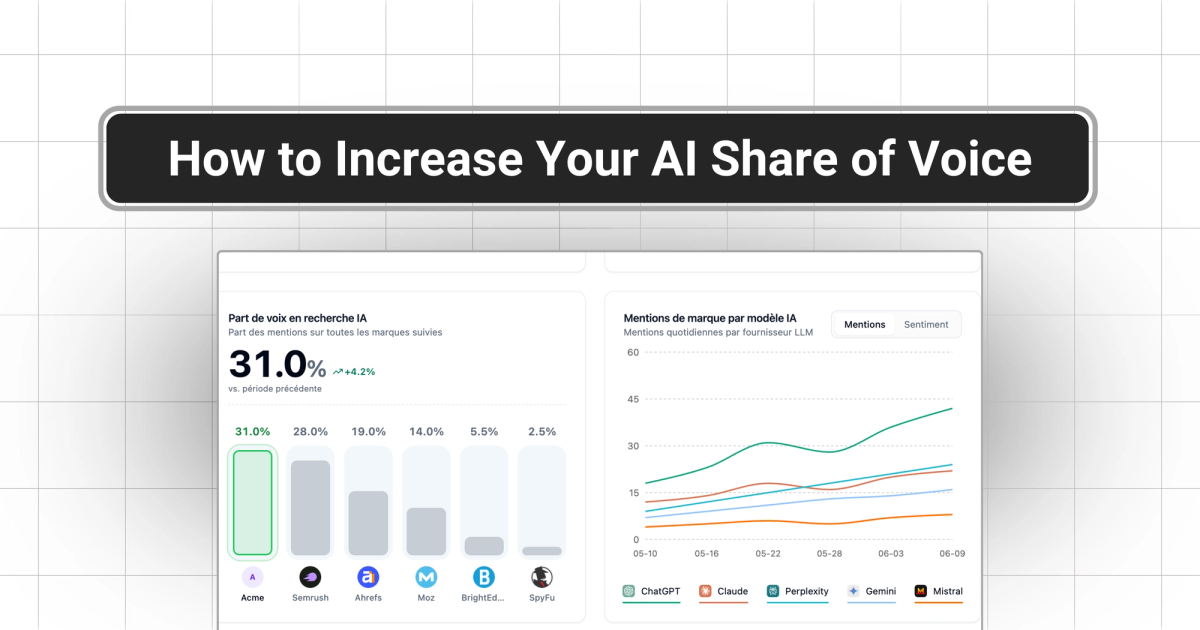
AI Share of Voice is the percentage of AI-generated answers across a defined prompt set that mention your brand, divided by total brand mentions in those same answers, multiplied by 100. If you do not yet have a baseline, read our methodology guide on measuring AI Share of Voice first. The rest of this post assumes you have a number to improve on.
The seven tactics below pull one of three levers. Getting cited in places LLMs scrape. Structuring your content so LLMs prefer to lift it. Earning the entity associations LLMs encode during training.
Tactic 1: Get Cited in Tier-One Editorial Coverage
ChatGPT favours brands with deep historical editorial presence. Maximus Labs' 30-sample methodology study found that a single citation in a tier-one publication can lift mention rate by 8 to 12 points on a given prompt set within 60 days. Pitch authentic founder interviews. Contribute to industry trend pieces. Accept podcast invitations that get transcribed and indexed. One contributed article in a publication LLMs trust outweighs ten guest posts on low-authority sites.
Tactic 2: Strengthen Your Presence on G2, Capterra and Industry Directories
Directory listings are LLM gold. G2, Capterra, Software Advice and category-specific directories are scraped frequently. A complete profile with verified screenshots, recent reviews and an accurate category placement signals legitimacy. Audit your listings quarterly. Stale category tags and missing alternatives sections cost you mentions on comparison prompts like "best X for Y".
Tactic 3: Write Definition-First Content with Quotable Paragraphs
LLMs lift the most quotable two-to-three-sentence passages from any page. If your H2 opens with "X is..." and gives a clean definition in 40 to 60 words, you hand the model a clean unit to cite. Bury the same definition four paragraphs deep and you give it nothing. This is the single highest-leverage on-page change you can make this quarter.
Tactic 4: Build a Wikipedia Presence and Knowledge Panel
Wikipedia, Wikidata and Google's Knowledge Graph propagate to nearly every LLM training corpus. If your brand has a notable claim (a funding round, a product launch covered by tier-one press, founder credentials) and you do not yet have a page, this is worth a one-time investment. Hire an editor who knows Wikipedia's notability standards. Do not edit it yourself. Approval can take months and the downstream effect on AI mentions is durable.
Tactic 5: Monitor and Respond Across All Seven Engines, Not Just ChatGPT
Only 11% of cited domains overlap between platforms. Siftly's 2026 measurement guide shows a brand winning on ChatGPT can be invisible on Perplexity, where 28% of B2B research now starts. Tracking only one engine means you cannot tell whether your tactics are landing in the markets where your buyers actually look. You need daily measurement across ChatGPT, Claude, Gemini, Perplexity, Mistral, DeepSeek and Grok.
Tactic 6: Earn Backlinks from Sites LLMs Frequently Cite
Not all backlinks are equal in the GEO era. The high-leverage ones come from sites that LLMs themselves return as sources. Map the top 500 source domains for your category and target outreach there. Forbes, Harvard Business Review, industry trade press and reputable Substacks dominate most B2B categories. A single link from one of those domains often outperforms a dozen low-authority links.
Tactic 7: Optimize Your Site for AI Retrieval (Schema, FAQs, llms.txt)
Three on-site changes have the largest impact. First, FAQPage and Article schema with concrete, scoped answers. Second, an llms.txt file at your root that gives LLMs a curated map of your most important content. Third, internal links with descriptive anchor text rather than "click here". None of these are silver bullets on their own. Together they make every other tactic land harder.
How to Know Which Tactic Is Working
Pick a baseline before you start. Define a representative prompt set of 50 to 300 prompts in your category and measure your AI Share of Voice across all seven engines for two weeks. Then implement tactics in 30-day sprints and measure deltas per platform. Vizible AI's GEO dashboard runs the full measurement loop daily so you can attribute every gain to a tactic instead of guessing at correlations.
Expect lift to compound. Tactics 1 through 4 build the underlying brand associations LLMs encode. Tactics 5 through 7 surface and amplify them. Most teams see the first measurable lift around day 45 if they commit to the full set.
A 90-Day Rollout Plan: Sequencing the 7 Tactics
Citation volume for the same brand can differ by up to 615x between engines like Grok and Claude depending on how well content is sequenced and optimized for each. Running all seven tactics at once spreads effort too thin. Sequencing them into a 90-day rollout produces measurable results faster and lets you attribute gains to specific changes instead of guessing.
Days 1–30: Fix Your Content Foundation (Tactics 3 and 7)
Start with the changes that land fastest: definition-first content (Tactic 3) and on-site AI retrieval signals like schema and llms.txt (Tactic 7). Audit your 10 to 15 most important pages and confirm AI crawlers can reach them. These structural fixes can lift Perplexity citations within two weeks since it crawls the live web continuously.
Days 31–60: Build Third-Party Authority (Tactics 1, 2, 4 and 6)
AI models weight what others say about you more than what you say about yourself. Layer in editorial coverage (Tactic 1), directory completeness (Tactic 2), Wikipedia presence (Tactic 4), and backlinks from frequently-cited domains (Tactic 6). Aim for at least five new third-party mentions in sources with meaningful domain traffic during this window.
Days 61–90: Measure Across All Seven Engines and Compound (Tactic 5)
Run your target queries across every engine and record which mention your brand, which cite competitors, and which cite neither. Brands that run this measure-and-adjust cycle consistently report 40 to 60% citation rate improvements within 90 days, according to the 2026 GEO Benchmark study from ConvertMate, because each citation compounds into more brand signal and a higher probability of future citations.
Frequently Asked Questions
How quickly can I improve my AI Share of Voice?
Most measurable lift arrives between days 30 and 90 of a coordinated effort. On-site changes (Tactic 3 and Tactic 7) show effects fastest, often within two weeks. Editorial citations and Wikipedia work compound over months and produce the most durable gains. There is no overnight tactic that survives the next platform update.
Do I need a separate strategy for each AI engine?
No. The seven tactics above lift your visibility across all major engines because they target the underlying signals every LLM uses: editorial citations, directory presence, entity associations, and on-site clarity. You will see different gain curves per platform, which is exactly why daily measurement matters.
Is GEO replacing SEO?
It is layering on top of it. The same authority signals (backlinks, mentions, schema, content quality) drive both. The difference is that AI engines pull your definitions and lists into their answers rather than sending traffic to your site. You need both, SEO for the click-driven journey and GEO for the answer-driven one.
Can a small brand realistically increase its AI Share of Voice?
Yes, especially in niche categories where the competitor set is small. The fastest wins for small brands are Tactic 3 (definition-first content) and Tactic 2 (directory completion). Tactic 4 (Wikipedia) is harder and requires genuine third-party coverage first. Focus on the on-site and directory levers before chasing editorial.
What is the most expensive GEO mistake?
Optimizing one engine and ignoring the others. Most agencies still report ChatGPT visibility as a proxy for total AI presence. BirdEye's 2026 AI search analysis found that with only 11% of cited domains overlapping between platforms, that proxy is wrong most of the time. A brand showing 40% mention rate on ChatGPT can show 8% on Perplexity in the same week.
See Your AI Share of Voice Today
If you cannot tell me what your AI Share of Voice is today across the seven engines your buyers use, you cannot improve it. Vizible AI runs your prompts daily across all seven engines and shows you which tactics are moving the number. Start your 7-day free trial and see your real baseline before you spend a euro on agency work.