



How to Track Your Brand Mentions in AI-Generated Answers
73% of B2B buyers now use AI tools like ChatGPT and Perplexity during their purchase research, according to a 2026 multi-source analysis published by PRNewswire. Yet only 22% of marketers currently track whether their brand appears in those answers. If you want to track brand AI mentions and have not set up a workflow yet, you are missing signals on a channel that already shapes more buying decisions than your newsletter.
What Are Brand AI Mentions and Why Do They Matter?
Brand AI mentions are the instances where an AI platform names your company, product, or service inside a generated answer. Tracking them is the practice of systematically querying ChatGPT, Perplexity, Gemini, Claude, and similar platforms with the questions your customers actually ask, then recording whether your brand appears, how it is described, and which sources the AI cites to support its answer.
This is not social listening or Google alerts. Those tools watch what humans publish about you. AI mention tracking watches what machines say about you in real time, which is the impression millions of buyers now form before they ever reach your website.
The variability of AI answers makes consistent tracking essential. ChatGPT has less than a 1% chance of returning the exact same brand recommendation list twice for the same prompt, based on 2026 tracking data. A one-off check tells you nothing. You need a repeatable workflow that surfaces patterns across time, platforms, and prompt types.
AI search traffic is worth chasing: it converts at 14.2% compared to Google organic’s 2.8%, a five-fold advantage (2026 data). Knowing where your brand stands in AI answers is not a vanity metric.
Why Your Current Analytics Cannot Track AI Brand Mentions
Standard web analytics were not built for this. When a buyer reads a Perplexity answer that mentions your brand and then visits your site directly, that session registers as direct traffic, not referral. When ChatGPT includes an inline link to your page, the visit appears as a ChatGPT.com referral only if the user clicks through. The brand influence that happened inside the AI answer leaves no trace in your dashboard.
This gap is why 58% of consumers now use generative AI instead of traditional search for recommendations (Similarweb GenAI Brand Visibility Index, 2026), yet most marketing teams have no measurement in place for it. You may be cited positively by Gemini every single day and see nothing in Google Analytics. You may be absent from ChatGPT answers in your core category and attribute the slow quarter to seasonality.
The problem compounds across platforms. ChatGPT, Perplexity, Gemini, Claude, and Mistral each weight sources differently. A brand that appears consistently in Perplexity answers may be completely absent from Gemini. Monitoring only one platform, or relying only on web analytics, gives you a dangerously partial picture of your AI share of voice. You can read more about how these models differ in our post on why your site ranks on Google but gets ignored by AI chatbots.
The Three Signals Worth Monitoring
Effective AI brand monitoring tracks three things: mention frequency, answer framing, and citation sources. Each one tells you something different.
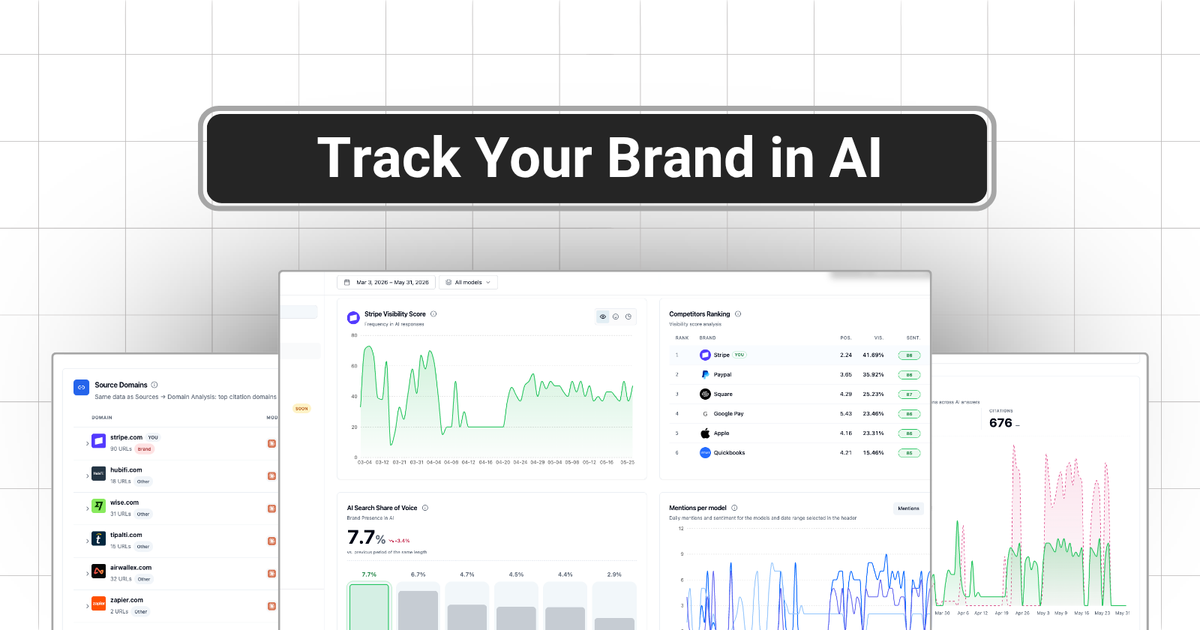
Mention frequency is how often your brand appears when a defined set of buyer-intent prompts is run against each platform. This is your AI Share of Voice: a number you can trend week over week instead of a one-off screenshot. VizibleAI tracks this across ChatGPT, Perplexity, Gemini, Claude, and Mistral and presents it in a single dashboard at vizibleai.com.
Answer framing is how the AI describes your brand when it does mention you. A mention that positions you as “a lower-cost alternative for teams that cannot afford the market leaders” is technically a mention, but it does not help. Framing analysis tells you whether AI platforms are reinforcing or undermining your positioning.
Citation sources are the specific pages the AI pulls from to construct its answer. Knowing which of your pages get cited tells you what content is working and which gaps to close.
Here is a concrete example. A SaaS company runs 40 buyer-intent prompts across four platforms each week. It finds that Perplexity cites its comparison page in 70% of answers, but ChatGPT never does. That single finding tells the team to reformat the comparison page with more explicit structure, direct answers, and named data sources, which is what ChatGPT’s retrieval logic favors. Four weeks later, ChatGPT citation frequency doubles. That is the feedback loop that AI brand monitoring enables.
How to Build an AI Brand Monitoring Workflow
Start with your prompt set. Write 20 to 40 questions that a potential customer would type into an AI when considering your category. Include category questions (“what is the best tool for X”), problem questions (“how do I solve Y”), and head-to-head comparisons (“X vs Y for use case Z”).
Run those prompts across each platform at least once a week. For each response, log whether your brand appears, its position in the answer (first mention, third mention, or absent), the framing, and the URL cited. Consistency matters more than frequency: a weekly workflow run reliably beats a daily one that gets skipped.
Brands that publish 12 or more optimized content pieces achieve up to 200x faster AI visibility gains than those publishing four or fewer, according to Brandi AI’s 2026 analysis. Your monitoring workflow closes the loop: it identifies which content is being picked up and where you need to publish next. For a deeper look at what makes content citable, see our post on how Perplexity decides which sources to cite in its answers.
Frequently Asked Questions
How often should I run AI brand monitoring prompts?
Weekly is the minimum for most brands. AI models update their retrieval behavior frequently, and a monthly snapshot will miss meaningful shifts. If you are running an active GEO campaign or operating in a competitive category, daily monitoring gives you the feedback loop needed to respond quickly.
Does it matter which AI platform I track brand mentions on?
Yes, significantly. ChatGPT, Perplexity, Gemini, Claude, and Mistral each pull from different source types and rank authority differently. A brand that dominates Perplexity answers may be absent from Gemini. Monitoring only one platform produces a misleading picture of your actual AI share of voice across the full buyer journey.
Can I track AI brand mentions manually without a dedicated tool?
You can start manually: run a defined prompt set and log results in a spreadsheet. The limits are scale and consistency. Humans skip prompts, miss framing nuances, and cannot run 40 queries across five platforms reliably every week. Manual tracking works as a starting point, but it breaks down as a production workflow once your prompt set grows.
What should I do when I find a negative AI mention?
Identify the source the AI is citing to construct that framing. If it is a review, an outdated piece of your own content, or a competitor comparison page, counter it with a newer, better-structured page that takes a clear position. AI models favor recent, direct, evidence-backed content. Publish the corrective content and monitor whether the framing shifts over four to six weeks.
Track Your AI Brand Mentions with Vizible AI
Vizible AI runs your prompt set across five AI platforms on your schedule and surfaces mention frequency, answer framing, and citation sources in one dashboard. Start your 7-day free trial at vizibleai.com and know exactly where your brand stands in AI-generated answers today.