



What Is AI Share of Voice and How Do You Measure It?
AI-referred search traffic grew 527% year-over-year between 2024 and 2025 (Marketing LTB, 2025), yet most marketing dashboards still show zero data on how often AI answers mention your brand. That gap is exactly what AI share of voice was built to close. If you want to know whether ChatGPT, Perplexity, or Google’s AI Overviews are recommending your company, your competitors, or nobody in your category at all, AI share of voice gives you the answer. This article explains what it is, how to calculate it, and how to start tracking it today.
What AI Share of Voice Actually Means
AI share of voice is the percentage of AI-generated responses, across a defined set of queries and platforms, in which your brand appears relative to all brand mentions in that same sample. If you run 100 prompts related to your category and your brand appears in 18 responses while your top three competitors appear in 56 combined, your AI share of voice for that query set is 24%.
AI share of voice is the GEO equivalent of traditional share of voice. Classic share of voice measured advertising impressions, search result appearances, or media coverage. AI share of voice measures something structurally different: presence inside the answer itself. AI models do not display ten results and let the user decide. They write a response, name sources, and move on. If your brand is not in that response, you do not exist for that user in that moment.
The formula is: AI SOV = (your brand mentions / total brand mentions across all tracked prompts) × 100. The complexity is not in the formula. It is in the inputs. You need to define which prompts represent your category, which platforms to query, and how many times to run each prompt to account for the non-determinism of large language models. Get those inputs right, and the number becomes a reliable compass.
This metric sits at the core of Generative Engine Optimization (GEO), the discipline of improving how AI systems perceive, describe, and recommend your brand. You can read more about the broader GEO framework on VizibleAI.
Why Your SEO Rankings No Longer Predict AI Visibility
Google’s AI Overviews appear on roughly 48% of Google queries as of March 2026, up from 34.5% just three months earlier (Dataslayer, March 2026). When an AI Overview appears, organic click-through rate drops 61% for the results below it (Seer Interactive, September 2025). A brand ranking number one on Google still loses most of its clicks when an AI answer sits above the fold.
The structural shift goes deeper than click rates. The overlap between top-10 Google rankings and the sources cited in AI Overviews collapsed from 75% in mid-2025 to between 17% and 38% by early 2026 (The Digital Bloom, 2026). Ranking well and being cited by AI are now two separate competitions. Winning the first one does not mean winning the second.
Traditional SEO metrics measure your position in a list. AI share of voice measures whether your brand is part of the answer. These require different measurement approaches and, increasingly, different content strategies. A brand that invests only in keyword rankings while ignoring AI mentions will lose visibility that does not show up anywhere on its current dashboard until the traffic decline becomes impossible to ignore.
The practical implication: every brand today needs two parallel visibility scores. One for organic search, one for AI mentions. AI share of voice is that second score.
The Four Dimensions of AI Share of Voice
A single mention percentage undersells what AI systems actually do with your brand. Tracking AI share of voice well means monitoring four dimensions, not one.
Frequency is the baseline: how often does your brand appear across a standardized set of test prompts? This raw count feeds the share calculation and gives you the headline number to benchmark against competitors.
Prominence measures where in the response your brand appears. A mention in the opening sentence of an AI answer carries far more weight than a parenthetical aside in the third paragraph. Brands that appear prominently get associated with authority. Brands buried at the bottom of a recommendation list get filtered out by readers who stop reading after the first two names.
Sentiment tracks how AI models characterize your brand when they mention it. A mention that calls your product “expensive compared to alternatives” is not the same as a mention that describes it as “the category standard for enterprise teams.” Positive framing correlates with conversion from AI-driven traffic. Neutral or negative framing can suppress it even when frequency is high.
Citation rate matters most for referral traffic. Perplexity links to sources in over 77% of its responses (LLM Pulse, 2025), making it the highest-value platform for brands that want clicks alongside mentions. ChatGPT is less consistent with inline citations in conversational responses, but a mention there still shapes brand perception at scale. Both types of presence matter, but they drive different downstream outcomes and need to be tracked separately.
How to Calculate Your AI Share of Voice
You calculate AI share of voice by querying AI platforms systematically, recording which brands appear in each response, and dividing your mention count by the total mentions across all responses in the sample.
The process has five steps.
Build a prompt set that mirrors real buyer language. Use questions, not keywords. “What is the best project management software for remote teams?” is a far better test prompt than “project management software tools.” Aim for 30 to 50 prompts per category. Include question types that cover awareness (“What tools do teams use for X?”), comparison (“What is better, X or Y?”), and recommendation (“Which X should I buy?”).
Run each prompt multiple times on each platform. Large language models are non-deterministic: the same question can produce meaningfully different answers depending on timing, model version, and sampling randomness. Running each prompt five times per platform and averaging results removes most of the noise.
Parse responses for brand mentions. Count your brand separately from each competitor. Record the position of each mention, whether it appears in a citation link, and whether the framing is positive, neutral, or negative.
Calculate your AI SOV. Sum your brand mentions across all prompts and runs. Divide by the total brand mentions (yours plus all competitors) across the full prompt set, then multiply by 100. That is your AI SOV percentage for that sample.
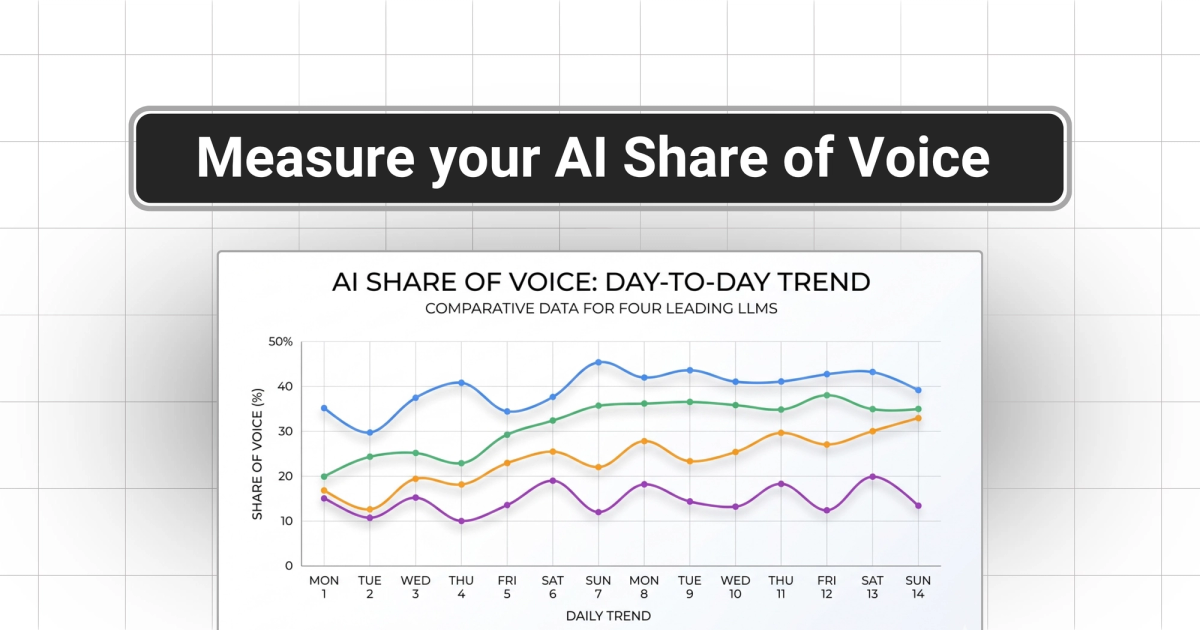
Track this score over time. A one-time snapshot tells you almost nothing. Monthly tracking over several months reveals whether your content investments are actually shifting AI perception in your favor. Consistent improvements in AI SOV typically become visible within 60 to 90 days of a systematic content and earned media program (AuthorityTech, 2026).
Which Platforms to Prioritize in 2026
Not all AI platforms generate equal value for every brand, and you do not have to track all of them with the same intensity.
ChatGPT holds 60.7% of the AI search market and 47% of B2B buyers name it as their preferred LLM for research (AuthorityTech, 2026). It is the non-negotiable first platform for any brand doing AI SOV tracking. ChatGPT drives brand awareness more than direct referral clicks, because it does not consistently provide inline source links in conversational responses. Being mentioned there means being part of the mental shortlist that buyers carry into their next search.
Google Gemini surged from 5.7% to 21.5% of AI chatbot traffic between early 2025 and early 2026 (AImagicx, 2026). Its tight integration with Google Search makes it critical for brands already invested in traditional SEO. Gemini feeds Google AI Overviews, which means improving your Gemini mentions can simultaneously lift your Google AI Overview appearances.
Perplexity is the referral traffic leader despite lower market share. Its citation-first format means every mention has a direct path to your website. For brands where website visits drive pipeline, Perplexity outperforms ChatGPT on return per mention.
Claude holds significant share in professional, developer, and research contexts.
Grok has grown through the X ecosystem and skews toward business and tech audiences.
A complete AI SOV measurement in 2026 requires ChatGPT, Gemini, and Perplexity as a baseline, with Claude and Grok added for brands that serve technical or professional audiences.
A Worked Example: Measuring AI SOV for a SaaS Brand
Consider a mid-market CRM company that wants to know how often AI answers recommend them when users ask about customer relationship management tools.
They build a prompt set of 40 questions covering different buyer intents. Examples include:
“What CRM should a 50-person sales team use?”
“Which CRM integrates best with marketing automation tools?”
“What is the best affordable CRM for B2B companies?”
They run each prompt five times on ChatGPT, Gemini, and Perplexity. That produces 600 total response observations (40 prompts × 5 runs × 3 platforms).
Their brand appears in 72 of those responses. Their two main competitors appear 84 and 54 times respectively. Total brand mentions across all 600 observations: 210. Their AI share of voice: 72 ÷ 210 × 100 = 34.3%.
That is a strong result. Top-performing brands capture 15% or more of AI share of voice across their core query sets, with enterprise leaders reaching 25 to 30% in specialized verticals (LLM Pulse, 2026). At 34.3% overall, this brand looks healthy. But when they filter the data to prompts specifically about affordable CRM options, their share drops to 12%. That is the gap. They need to publish content, earn citations from publications that cover budget-friendly software, and build authority signals specifically around price-sensitive buyer questions.
The breakdown by platform tells another story. Their Perplexity citation rate is low even though their ChatGPT mentions are strong. That means they have awareness without traffic. A targeted effort to earn Perplexity-relevant citations would convert existing AI awareness into website visits.
How to Improve Your AI Share of Voice
Your AI SOV score is an output. The inputs are content authority, citation patterns, and brand presence across the broader web.
Publish content that directly answers your prompt set. AI models cite sources that match query intent precisely. A post titled “What CRM Should a 50-Person Sales Team Use?” is far more likely to be cited when that exact question is asked than a generic “CRM comparison” landing page. Answer-first content that leads with the conclusion, provides specific figures, and covers a single question deeply is what AI citation algorithms reward.
Earn citations from trusted publications. AI models learn citation-worthiness partly from who links to you and who mentions you alongside credible sources. A mention in a recognized industry publication, a G2 or Capterra profile, or a journalist’s round-up piece carries more signal than dozens of low-authority directory listings.
Deliberately grow your web mention volume. Brands in the top 25% for web mentions receive 10× more AI visibility than those below that threshold (Similarweb, 2026 AI Brand Visibility Index). AI systems form brand associations from the full corpus of text they train and retrieve from, not just from structured data or backlinks. More co-occurrences of your brand name alongside the key problems and categories you solve will lift your AI SOV over time.
Use a monitoring tool to close the feedback loop. VizibleAI tracks your brand mentions across ChatGPT, Perplexity, Gemini, Claude, and Google AI Overviews continuously, surfacing your AI share of voice score, prominence data, and competitor benchmarks in a single dashboard. Without automated tracking, you are flying blind. No team can manually query five platforms with 50 prompts five times each, every week, and turn that into a reliable trend line.
Frequently Asked Questions About AI Share of Voice
What is AI share of voice?
AI share of voice is the percentage of AI-generated responses, across a defined prompt set and set of platforms, in which your brand appears relative to all brands mentioned in the same sample. It is calculated as your brand mention count divided by total brand mentions across all tracked prompts, multiplied by 100.
How is AI share of voice different from traditional share of voice?
Traditional share of voice measures advertising impressions, organic search appearances, or media coverage. AI share of voice measures whether your brand appears inside AI-generated answers on platforms like ChatGPT, Perplexity, and Gemini. The two metrics now diverge sharply: high Google rankings no longer guarantee AI mentions because the overlap between top-10 rankings and AI citations fell from 75% in mid-2025 to between 17% and 38% by early 2026 (The Digital Bloom, 2026).
Which AI platforms should I track for share of voice?
Start with ChatGPT, Google Gemini, and Perplexity as your baseline. ChatGPT holds the largest AI search market share. Gemini is growing fast and feeds Google AI Overviews. Perplexity drives the most referral clicks because it cites sources in over 77% of its responses. Add Claude and Grok if you serve technical or professional audiences.
How many prompts do I need to measure AI share of voice accurately?
Use at least 30 to 50 prompts that mirror how real buyers describe their problem and compare solutions. Run each prompt at least five times per platform to account for LLM non-determinism. Fewer prompts produce unreliable snapshots. More prompts with repeated runs produce a stable score you can track over time.
How long does it take to improve AI share of voice?
Consistent improvements in AI SOV typically become visible within 60 to 90 days of a systematic content and earned media program (AuthorityTech, 2026). Major shifts in how AI models categorize your brand relative to competitors generally require 6 to 12 months of sustained output.
Track Your AI Share of Voice with VizibleAI
You now know what AI share of voice is, how to calculate it, which platforms matter, and what drives it up. The next step is to run the measurement for your own brand. VizibleAI gives you a full AI share of voice dashboard across ChatGPT, Perplexity, Gemini, Claude, and Google AI Overviews, with competitor benchmarks and trend tracking built in. Start your 14-day free trial today and find out exactly where your brand stands in the AI answers your buyers are reading right now.