



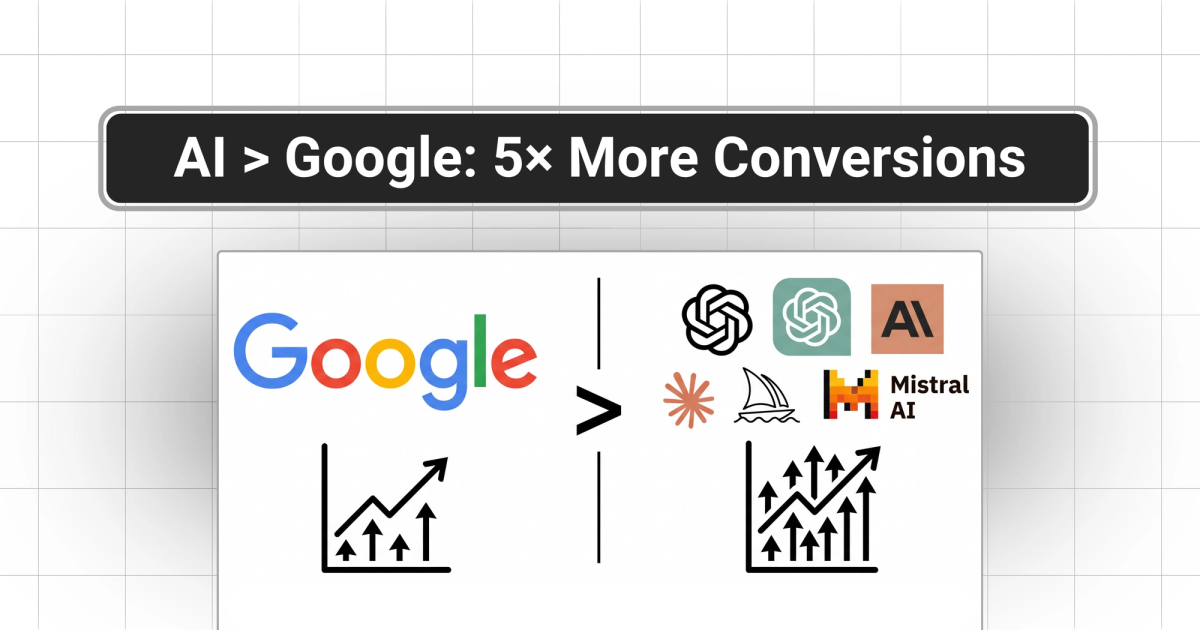
Why Does AI Search Traffic Convert 5x Better Than Google Organic?
Visitors who arrive on your site from an AI engine citation convert at 14.2% on average, compared with 2.8% for Google organic traffic, according to 2026 research by GEO analytics firm Brandlight. That five-to-one gap is not a rounding error. It reflects a structural difference in how AI-referred visitors behave relative to users who scan a list of blue links and click the one that looks most relevant. If AI search is not already a separate line in your analytics, you are missing the most valuable traffic segment of 2026.
What AI Search Traffic Is and Why It Is Not Just Another Referral Source
AI search traffic is the stream of visitors who click through to your site after an AI engine named your content in a generated answer.
ChatGPT, Perplexity, Gemini, Claude, and similar engines do not list links and let the user choose. They synthesize a response, incorporate external sources, and in many cases name specific brands and products as the answer to the user’s question. Visitors who follow those citations arrive with a very different state of mind than someone who clicked the third result in a Google SERP.
AI-referred traffic is qualified traffic by definition. The model has already evaluated dozens of sources, decided yours was relevant to the specific query, and passed that judgment to the user. That pre-qualification step is what the conversion numbers reflect.
In 2026, this matters at scale:
ChatGPT processes over 1 billion queries per week.
Google AI Overviews appear on more than 47% of all Google searches.
Perplexity reached 150 million monthly active users.
31.3% of the US population now uses generative AI search.
This is not a niche audience. It is the mainstream.
The 5x Conversion Gap: What the Numbers Show
The 14.2% versus 2.8% conversion gap comes from tracking conversion events across e-commerce, SaaS, and B2B service sites in 2026. The gap is consistent across sectors because its cause is structural: the purchase funnel has already progressed before the visitor arrives.
Consider a concrete example:
A software company tracking leads in May 2026 receives 2,000 visitors from Google organic and 200 visitors via Perplexity and ChatGPT citations.
At 2.8%, Google organic produces 56 leads.
At 14.2%, the 200 AI-referred visitors produce 28 leads.
The AI channel delivers half the leads from one-tenth the traffic. On a per-visitor basis, the ROI on AI visibility is five times higher than on Google ranking.
This dynamic compounds when you factor in purchase intent. A user who types a query into ChatGPT and reads a synthesized answer naming your product is further along the consideration journey than a user who clicked a keyword-matched blog post from position seven in Google. The AI has already done the comparison work. The visitor arrives at a conclusion, not a question.
Research from Brandlight in 2026 also shows that the overlap between top Google results and AI-cited sources has dropped from 70% to below 20%. Ranking on Google no longer predicts whether AI engines will cite you. The two are separate optimization problems.
Why AI Engines Create a Pre-Qualified Buyer
The mechanism behind the conversion advantage is that AI engines act as an intermediate qualifier.
When Perplexity answers a question such as “what tool should I use to monitor my brand in AI answers”, it:
Synthesizes information from multiple sources.
Compares options and trade-offs.
Constructs a concrete recommendation.
If your brand appears in that recommendation, the user who clicks your link is not browsing. They have received a recommendation from a source they already trusted enough to ask.
This is different from:
Paid ads, where the visitor is intercepted mid-intent.
Google organic, where the visitor is still choosing between options.
AI citation is closer to a peer recommendation delivered at the exact moment the user was ready to act. That is why conversion rates are five times higher, and why brands that earn consistent AI citations gain a compounding advantage over those that do not.
Understanding where your brand is being cited, by which engines, and for which queries is the first step. You can explore how AI Share of Voice measurement works in detail in VizibleAI’s guide to AI Share of Voice.
How to Make Your Content Worth Citing
Not all content earns AI citations. Brand-owned content accounts for only 5–10% of what AI engines draw from when building answers. The other 90%+ comes from external sources: news coverage, analyst reports, review platforms, and industry publications. Earning citations requires both strong owned content and an earned media presence that AI engines treat as independent validation.
1. Strengthen Owned Content for AI
On the owned content side, the formats that earn citations most reliably share specific traits. They:
Open with a direct answer to the question the user is likely asking.
Include specific statistics with named sources and years.
Define key concepts clearly and early.
Use concrete examples instead of vague generalizations.
Maintain topical focus on a single, well-defined question.
These are the signals AI engines use to identify credible, high-utility sources worth referencing.
2. Build Earned Media That Acts as Independent Proof
On the earned media side, the structure of GEO (Generative Engine Optimization) differs meaningfully from traditional SEO.
AI engines:
Pull heavily from third-party validation (news, analysts, review sites, niche publications).
Reward consistency of claims across multiple independent sources.
Care less about classic SEO signals like backlink volume and more about clarity, authority, and corroboration.
The GEO vs SEO breakdown at VizibleAI explains the full shift in how optimization works when AI answers replace link lists.
FAQ
Is AI search traffic large enough to move the needle for most brands?
Yes. With ChatGPT processing over 1 billion queries per week and Google AI Overviews appearing on nearly half of all searches, the volume of AI-referred traffic is already material for most sectors. The conversion rate advantage means even a small share of AI citations can produce revenue disproportionate to raw traffic numbers.
Why does AI-referred traffic convert so much higher than Google organic?
Because the AI engine has pre-qualified the visitor. By the time someone reads a synthesized answer that names your brand as the relevant solution and then clicks through, they have moved past the comparison stage. They arrive with:
A specific intent.
A baseline level of brand familiarity.
A sense that your product is a recommended answer, not just one option in a list.
Organic visitors rarely have that combination.
Do smaller brands have a realistic chance of earning AI citations?
Yes. AI engines do not rank sources by domain authority the way Google does. A smaller site with a precisely written, well-cited answer to a specific question can appear in an AI response ahead of a large brand with generic content. Specificity and credibility signals matter more than overall site authority.
How do I separate AI referral traffic in my analytics?
In Google Analytics 4, create segments filtering by source domains such as:
chat.openai.com
perplexity.ai
gemini.google.com
claude.ai
For a cross-engine view of your citation rate and AI Share of Voice, Vizible AI aggregates this data into a single dashboard.
How quickly can content changes affect AI citation rates?
AI engines update their source preferences on different timescales:
Perplexity re-indexes sources frequently.
ChatGPT’s web search layer updates in near real time for browsing queries.
Changes to well-structured content can affect citation patterns within days to a few weeks, depending on the engine and query type.
See Your AI Conversion Opportunity Today
If you are not measuring AI search traffic separately, you are undervaluing your most conversion-efficient channel and flying blind on where citations are and are not happening.
VizibleAI:
Tracks your brand across ChatGPT, Perplexity, Gemini, and Claude.
Converts citation data into an AI Share of Voice score.
Shows you which content is earning the citations that drive high-converting traffic.
Start your 7-day free trial at vizibleai.com.