

Why Your Site Ranks on Google But Has Zero AI Chatbot Visibility
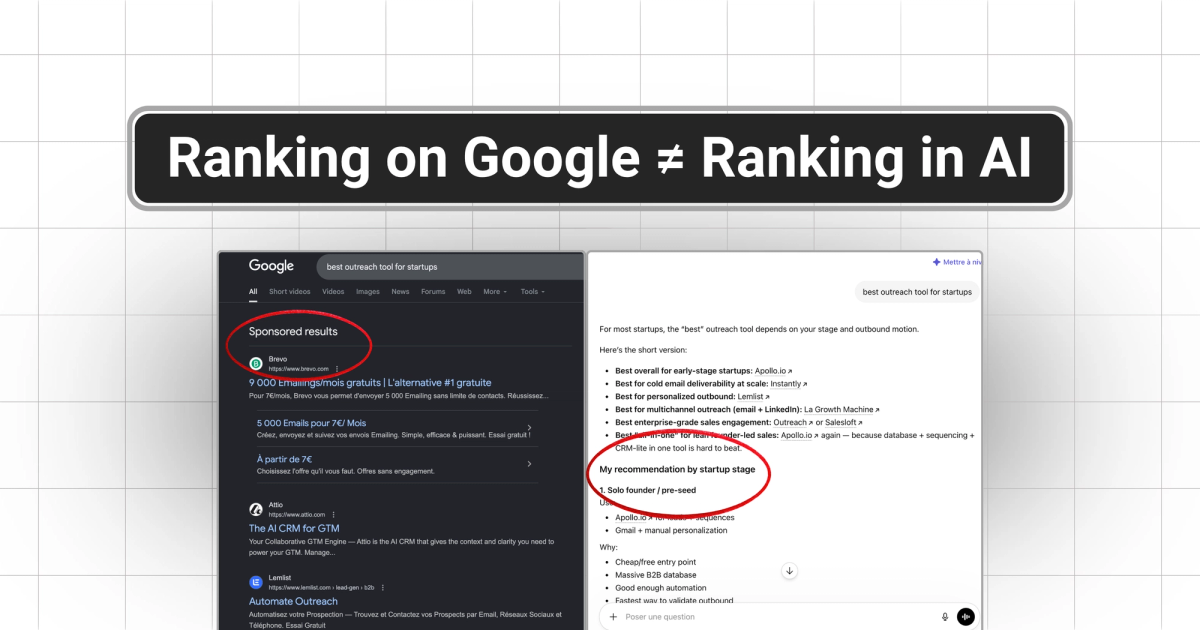
Only 11% of domains cited by ChatGPT and Perplexity appear in each other’s citation pools, according to a 2026 analysis of 680 million citations (Superlines, 2026). Your site can hold a page-one Google ranking and still have zero AI chatbot visibility. It is not a glitch. It is a structural difference in how these two systems decide what to surface.
Google Rankings and AI Chatbot Visibility Follow Different Rules
AI chatbot visibility is the measure of how often your brand or content appears inside the answers generated by AI-powered tools such as ChatGPT, Perplexity, Gemini, and Claude. It depends not on your position in a ranked list but on whether AI models have encountered your brand in credible contexts often enough to treat you as a reliable source worth citing.
Google’s algorithm rewards on-site quality: fast-loading pages, keyword-relevant content, and a strong backlink profile. AI citation systems reward something different. They look for external authority, meaning your brand appearing in third-party sources like industry publications, analyst reports, review platforms, and community forums. They favor structured, extractable answers that a language model can lift and cite directly. And they respond to content freshness in ways that Google does not always reward at the same speed.
A brand that has invested years in technical SEO can dominate Google and be completely absent from ChatGPT answers. The two systems are not measuring the same thing, and treating them as equivalent is the most common mistake brands make when they first discover the gap. The good news is that the fix is learnable once you understand the underlying logic of each system.
The Overlap Between Google Rankings and AI Citations Is Just 11%
The data makes the gap concrete. A 2026 analysis of 680 million citations found that only 11% of domains are cited by both ChatGPT and Perplexity (Superlines, 2026). Research from LLM Audit in 2026 sharpened this further: 28.3% of ChatGPT’s most-cited pages have zero visibility in Google’s top results. These are sources that Google’s ranking algorithm effectively ignores, but that AI models rely on consistently.
Consider a concrete example. A mid-size B2B software company ranks on page one of Google for “project management software for agencies.” Their on-site SEO is strong, their page speed is excellent, and their backlink profile is healthy. But when a prospective customer asks ChatGPT “what project management tool is best for agencies,” they do not appear. The reason: their brand appears in only four external publications, none of them major. A competitor with weaker Google rankings but 45 external mentions across industry blogs, review platforms, and Reddit threads appears in the AI answer on every test.
The gap is structural, not accidental. Google measures what happens on your site. AI models measure what the broader web says about you.
What AI Chatbots Actually Look for When Picking Sources
Each platform has a distinct citation logic, and understanding it helps you prioritize your effort.
ChatGPT blends its training data with selective web retrieval. It tends to favor sources with high domain authority, consistent external citation, and content that has appeared across multiple credible sites over time. It is less sensitive to recency than Perplexity. A 2026 benchmark report from Averi found that 73% of B2B buyers now use ChatGPT or Perplexity in their research process, which means being absent from those answers carries direct commercial risk.
Perplexity runs a live web search for every single query, drawing from Google and Bing APIs, and synthesizes an answer with numbered inline citations. A 2026 analysis found that Perplexity cited content published within the last 30 days at an 82% rate (Superlines, 2026). That means a well-structured, recently published or updated page has a fast path into Perplexity responses, even without high domain authority.
Google AI Overviews blend organic ranking signals with additional citation criteria. Pages cited inside an AI Overview earned 35% more organic clicks than non-cited competitors appearing on the same results page, according to Position.digital in 2026. That uplift makes AI Overview inclusion a compounding advantage: you win on ranking and on click-through at the same time. Optimizing for AI Overviews is therefore worth pursuing even for brands with strong existing organic performance, because the citation layer adds a measurable click premium on top of what you already earn.
Three Signals That Improve AI Chatbot Visibility
Closing the gap requires targeting what these systems actually measure, not the signals Google rewards.
External mentions matter most. Your brand needs to appear in the sources AI models treat as credible: industry publications, comparison platforms, analyst reports, and active community forums. One well-placed mention in an authoritative trade publication can do more for your AI chatbot visibility than ten new blog posts published only on your own domain. Third-party validation is the currency AI citation systems run on. If your outreach and PR strategy has been focused purely on link-building for Google, it is time to broaden the goal to include citation-building for AI.
Answer-first structure makes your content extractable. AI models pull short, direct answers from source material. If your pages bury the answer after 200 words of context, the model may skip you entirely in favor of a competitor who leads with the answer. Write each H2 section so the opening 40 to 60 words stand alone as a complete, citable response.
Content freshness matters especially for Perplexity and Google AI Overviews. Both systems favor recently published or updated content. Refreshing a strong page with updated statistics and a new publication timestamp can re-enter your content into active citation pools within days, not months. A quarterly content audit, with targeted refreshes on your highest-value pages, is one of the highest-return actions you can take for AI visibility.
How to Measure Your AI Visibility Gap
Most brands discover the gap the hard way: a salesperson reports that prospects are naming competitors they found through ChatGPT. By then, the AI share of voice has already shifted, and recovering it takes time. The average recovery cycle, once a competitor has established AI citation dominance on a keyword cluster, runs between three and six months.
The better approach is to measure your AI chatbot visibility before the pipeline impact appears. VizibleAI tracks how often your brand appears in answers from ChatGPT, Perplexity, Gemini, and Claude across the queries that matter to your business. You get an AI Share of Voice score, a view of which competitors are being cited in your place, and the specific content gaps driving the difference. If you want to understand the underlying metric first, our guide to what AI Share of Voice is and how to measure it covers the methodology in detail.
Tracking is not optional. AI citation patterns shift as models update and as new content enters their retrieval pools. A brand that is well-cited today can drop from AI answers within weeks if competitors publish better-structured content or earn more external mentions. The signal needs to be continuous, and the brands that catch these shifts early are the ones that maintain their AI Share of Voice while others scramble to recover lost ground.
Frequently Asked Questions About AI Chatbot Visibility
Why does my site rank on Google but not appear in ChatGPT answers?
Google and ChatGPT measure different things. Google ranks your page based on on-site quality and backlinks. ChatGPT decides what to cite based on how often your brand appears across credible external sources and whether your content is structured for extraction. Strong SEO does not transfer automatically to AI chatbot visibility, and brands are often surprised by the size of the gap.
Do AI chatbots use Google rankings to determine what to cite?
No, not directly. Only 11% of domains cited by both ChatGPT and Perplexity overlap with top Google results (Superlines, 2026). Perplexity runs its own live web search per query. ChatGPT blends training data with retrieval. Neither system simply mirrors the Google ranking list, which is why strong Google performance gives you no guarantee of AI citation.
How quickly can I improve my AI chatbot visibility?
Perplexity responds fastest to fresh content: pages published or updated within the last 30 days are cited at an 82% rate in relevant answers (Superlines, 2026). ChatGPT improves more slowly, as its training updates are less frequent. External mentions in credible sources can lift ChatGPT visibility over a period of weeks to months, depending on how quickly those mentions propagate into retrieval pools.
Is improving AI chatbot visibility the same as doing GEO?
GEO (Generative Engine Optimization) is the practice; AI chatbot visibility is the outcome. GEO describes the set of actions you take to increase how often AI systems cite your brand. AI chatbot visibility is the metric that tells you whether those actions are working. The two concepts are inseparable in practice, and every GEO strategy should be tied to a measurable visibility target.
Which AI chatbots should I prioritize for brand visibility?
ChatGPT and Perplexity are the highest-priority platforms for most brands right now. A 2026 benchmark report (Averi, 2026) found that 73% of B2B buyers use ChatGPT or Perplexity in their research process. Google AI Overviews is critical for queries where you already compete in organic search. Gemini and Claude are growing in usage and worth monitoring alongside the two leading platforms.
See Your AI Chatbot Visibility Score Today
Your Google rankings tell you one story. Your AI chatbot visibility tells you another. Start a 14-day free trial with Vizible AI to see exactly where your brand appears in AI-generated answers, where it is being replaced by competitors, and what to fix first. The data takes minutes to set up. The clarity it gives you is immediate.